
Knowledge
Solid or stranded: conductor classes 1, 2, 5 and 6
What the class on the datasheet means for the termination, the bend and the choice between fixed and moving.
IEC 60228 defines four conductor classes: 1 solid, 2 stranded for fixed installation, 5 fine-stranded and 6 extra fine-stranded. Classes 1 and 2 are for fixed installation, 5 and 6 for moving work, although those may be installed fixed as well. A solid conductor that bends repeatedly work-hardens and fractures at the terminal. Fine-stranded belongs in a ferrule and makes a tighter bend.
IEC 60228 sets out four conductor classes. Class 1 is solid: one wire per core. Class 2 is stranded for fixed installation, at the common sizes seven wires laid up together. Class 5 is fine-stranded and class 6 extra fine-stranded, with far more and far thinner wires. Some types exist in two classes: YMvK Cca is class 1 or 2, depending on the size. At larger cross-sections the conductor is often stranded or fine-stranded, because a thick solid conductor is stiff and awkward to bend and terminate. So YMvK Cca moves from class 1 to class 2, and from 5G16 to YMvK ss Cca in class 5.
The dividing line runs between fixed and moving. Classes 1 and 2 are meant for fixed installation, classes 5 and 6 for flexible cable and cord, although 5 and 6 may be installed fixed as well. The other way round it goes wrong. Bend a solid or a class 2 conductor repeatedly and the copper work-hardens and eventually fractures, usually just behind the terminal where the movement starts.
You can see that choice across our range. VO-YMvKas is always solid class 1, VG-YMvKas stranded class 2. VOB is solid in the small sizes and stranded from 6 mm². The single-core wires H05V-K and H07V-K are class 5, as are rubber cable H07RN-F and signal cable LiHCH.
At the terminal you notice the difference first. A solid conductor goes straight under the screw. A fine-stranded one belongs in a ferrule, otherwise the wires splay out, the clamping force drops away and the contact resistance rises. Spring terminals come in versions for both; check what the terminal allows, not what still just fits.
The bend differs too. Our solid H07V-U and stranded H07V-R are allowed 6 × the outer diameter, the fine-stranded H07V-K 4 to 6 ×, depending on its diameter. With a cramped cabinet entry or a tight bend in the route, the conductor class can make the difference between fitting and not fitting. There is more on that in the article on bending radius.
For the buyer: the same type designation can exist in two classes, and each class is a separate product with its own price and lead time. Put the class on the enquiry line, especially if the cable goes into a drag chain, hangs off a moving part or has to make a tight bend.
Does the cable still have to move once it has been pulled in, or does it land on a terminal where core size is tight? Give us the type, the cross-section and the connection material. We will recommend the matching conductor class.
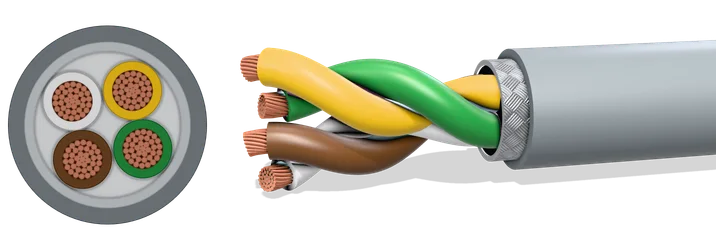
LiHCH-TP
LSZH flexible data cable, twisted pairs, screened
Lead time: 1–2 working days from stock
In stock: 6×2×0.5
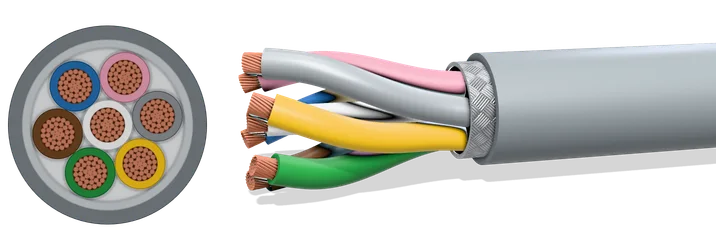
LiYCY
PVC flexible data cable, screened
Lead time: 1–2 working days from stock
In stock: 4×0.5 · 5×0.25 · 6×0.5 · 10×0.25