LiHCH-TP is the LiHCH with twisted pairs: twisting suppresses crosstalk, the tinned copper braid (about 85% coverage) keeps external interference out and the LSZH materials give little smoke and no corrosive gases in a fire. The halogen-free counterpart of LiYCY-TP. Core colours per pair to DIN 47100. The 6×2×0.5 is in stock in Dordrecht; other sizes on request.
LiHCH-TP is a flexible, screened, halogen-free data and signal cable in which the fine-stranded bare copper conductors are twisted in pairs, insulated with a halogen-free (LSZH) compound, stranded in layers and covered by an overall braid of tinned copper wires under a grey halogen-free (LSZH) outer sheath. The pair twisting reduces crosstalk between circuits, while the braid screen limits the influence of external electrical interference on the transmitted signal. In the event of fire the halogen-free materials develop little smoke and no corrosive gases, which suits public buildings, data centres and control rooms. It is the twisted-pair version of LiHCH and the halogen-free counterpart of LiYCY-TP. The cable is intended for the transmission of low-voltage data, measuring and control signals in dry and damp indoor locations, for fixed installation or occasional flexing without tensile load; it is not intended for outdoor use, direct burial or power distribution.
Also known as: halogen-free data cable · LSZH data cable · twisted pair
Applications
- Several signal pairs running close together in data centres and control rooms.
- Public buildings where the specification calls for low smoke and halogen-free.
- Fixed installation or occasional flexing without tensile load, indoors.
What to look out for
- Halogen-free and low smoke, but flame-retardant, not fire-resistant (no circuit integrity).
- No CPR class declared: as a connection cable for mobile equipment, LiHCH-TP falls outside EN 50575. Where the cable is installed permanently in a building and exposed to indoor air, the Bbl requires at least Dca. State with your enquiry which class your project needs and we will look into it for you.
- Twisted pairs work best when both cores of a pair carry the outgoing and return current of the same circuit.
- 250 V is a signal voltage, not for power distribution.
- Conductor
- Fine-stranded bare copper (class 5 acc. to IEC 60228 from 0.5 mm²).
- Insulation
- Halogen-free (LSZH) compound.
- Stranding
- Two cores twisted to a pair; pairs stranded in layers.
- Screen
- Braid of tinned copper wires over the stranded pairs, optical coverage approx. 85%.
- Sheath
- Halogen-free (LSZH) compound, grey.
- Core identification
- Colour code acc. to DIN 47100, paired.
- Rated voltage
- 250 V (not for power applications).
- Test voltage
- 800 V (0.14 mm²); 1,200 V (0.25 mm² and above).
- Standard
- Manufacturer specification based on DIN VDE 0812; conductor class 5 acc. to IEC 60228 (from 0.5 mm²); core colours acc. to DIN 47100.
- Flame-retardant
- Acc. to IEC/EN 60332-1-2.
- Halogen-free
- Acc. to IEC/EN 60754-1 and IEC/EN 60754-2 (no corrosive gases).
- Max. conductor temperature
- +70 °C.
- Permitted outer cable temperature, fixed
- −30 °C to +70 °C.
- Permitted outer cable temperature, flexing
- −5 °C to +70 °C.
- Min. bending radius, fixed
- 10 × outer diameter.
- Min. bending radius, flexing
- 15 × outer diameter.
LiHCH-TP or LiYCY-TP?
LiHCH-TP
- halogen-free insulation and sheath
LiYCY-TP
- PVC insulation and sheath
Both have twisted pairs under a tinned copper braid and core colours to DIN 47100. LiHCH-TP has halogen-free insulation and sheath, LiYCY-TP PVC. In a fire LiHCH-TP gives little smoke and no corrosive gases. Choose LiHCH-TP in data centres, control rooms and public buildings where that is specified; otherwise LiYCY-TP is enough.
View LiYCY-TP →LiHCH-TP or LiHCH?
LiHCH-TP
- cores twisted in pairs
LiHCH
- single cores in layers
In LiHCH-TP the cores are twisted in twos to form pairs; in LiHCH single cores are laid in layers. Twisting suppresses crosstalk between circuits. Both are halogen-free and screened with a tinned copper braid. Choose LiHCH-TP when each signal gets its own pair for the outgoing and return conductor, such as analogue measuring signals and data; choose LiHCH for individual control and switching signals.
View LiHCH →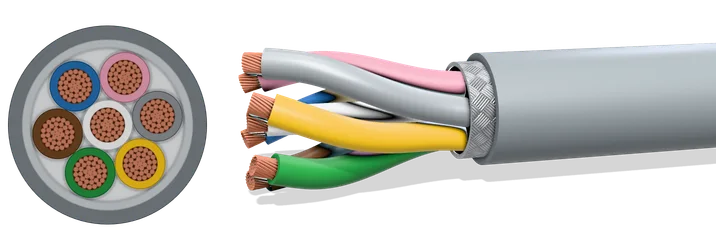
LiYCY
PVC flexible data cable, screened
Lead time: 1–2 working days from stock
In stock: 4×0.5 · 5×0.25 · 6×0.5 · 10×0.25
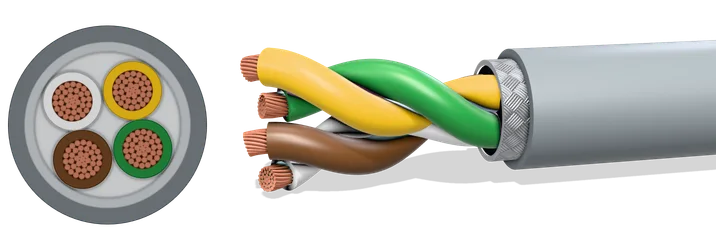
LiYCY-TP
PVC flexible data cable, twisted pairs, screened
Lead time: 1–2 working days from stock
In stock: 4×2×0.75
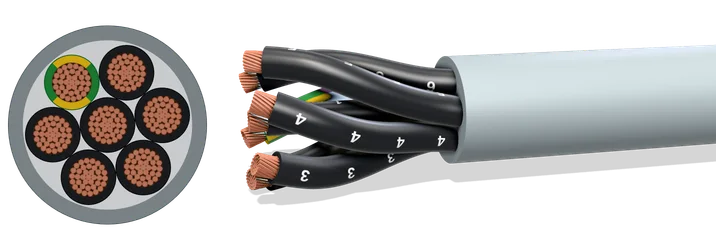
YSLY-JZ
PVC flexible control cable, 300/500 V
Lead time: On request; the lead time is stated in the quote.
Not seeing what you need? Just ask. Our range goes well beyond this list. Ask us →