
VG-YMvKas Dca
Power cable 0.6/1 kV, XLPE, steel wire armoured
VG-YMvKas Dca is the armoured underground cable for places where the cable has to take a knock: under roads, on industrial sites and on long pulls. Galvanised steel wire armour with earth continuity conductor (GSWA+ECC), XLPE insulation, 0.6/1 kV, KEMA. In stock in Dordrecht up to 4×240 mm².
Power cable for industrial applications, suitable for underground laying and for installations where there is a risk of mechanical damage, thanks to its galvanised steel wire armour.
Also known as: armoured underground cable
Applications
- Underground supply to buildings, halls and site lighting.
- Industrial installations with a risk of mechanical damage.
- Routes under paving where a braided cable (VO) is too light.
What to look out for
- The armour must be earthed at both ends via the ECC; use glands that clamp the armour.
- Heavier cross-sections come on shorter drum lengths. Fix the length breakdown with the enquiry.
- Single-core YMvKas has a magnetic steel armour, which heats up with alternating current. Single-core is therefore for DC; for AC, choose a multicore cable.
- Need aluminium? The VG-YMvKas Dca ALU is the counterpart for long routes and large cross-sections.
- Conductor
- Stranded copper, class 2.
- Insulation
- Cross-linked polyethylene (XLPE).
- Filler / bedding
- Polyvinyl chloride (PVC).
- Armour
- Galvanised steel wire armour (round wires on the smaller sizes, flat wires on the larger sizes, depending on the manufacturer) with an earth continuity conductor (ECC) of copper wires and a galvanised steel tape counter helix (GSWA+ECC).
- Outer sheath
- Polyvinyl chloride (PVC), flame retardant.
- Core identification
- Colour-coded acc. to HD 308 or numbered, to order. No green/yellow core: the protective earth runs through the earth continuity conductor (ECC) in the armour.
- Rated voltage Uo/U
- 0.6/1 kV.
- AC test voltage
- 3.5 kV.
- Temperature range
- −20 °C to +90 °C (conductor); +250 °C in short circuit.
- Min. bending radius
- 15 × outer diameter.
- Lead content
- Lead-free (Pb).
- Fire performance
- Flame-retardant acc. to IEC 60332-1-2 and IEC 60332-3-24.
- Standards
- HD 604-S1-4D. DEKRA K42D-1-1:2017 and DEKRA K42D-1-4-D:2017 (formerly KEMA-KEUR; 10 mm² and larger).
- Certificates
- KEMA, CE, Declaration of Performance (DoP), CPR (EN 50575).
Sizes and weights
| Cores × mm² | R DC 20 °C (Ω/km) | Outer Ø approx. (mm) | Weight approx. (kg/km) |
|---|---|---|---|
| 1×1.5 | 12.1 | 10.2 | 210 |
| 1×2.5 | 7.41 | 10.5 | 232 |
| 1×4 | 4.61 | 11.0 | 261 |
| 1×6 | 3.08 | 11.5 | 294 |
| 1×10 | 1.83 | 13.0 | 431 |
| 1×16 | 1.15 | 13.9 | 525 |
| 1×25 | 0.727 | 15.5 | 656 |
| 1×35 | 0.524 | 16.5 | 775 |
| 1×50 | 0.387 | 18.7 | 1039 |
| 1×70 | 0.268 | 21.3 | 1439 |
| 1×95 | 0.193 | 24.1 | 1933 |
| 1×120 | 0.153 | 25.9 | 2225 |
| 1×150 | 0.124 | 27.5 | 2603 |
| 1×185 | 0.0991 | 29.7 | 3076 |
| 1×240 | 0.0754 | 32.8 | 3752 |
| 1×300 | 0.0601 | 35.6 | 4493 |
| 1×400 | 0.0470 | 39.0 | 5414 |
| 2×1.5 | 12.1 | 13.4 | 355 |
| 2×2.5 | 7.41 | 14.2 | 403 |
| 2×4 | 4.61 | 15.1 | 476 |
| 2×6 | 3.08 | 16.1 | 546 |
| 2×10 | 1.83 | 18.2 | 748 |
| 2×16 | 1.15 | 20.2 | 960 |
| 2×25 | 0.727 | 23.6 | 1357 |
| 2×35 | 0.524 | 25.6 | 1665 |
| 2×50 | 0.387 | 28.9 | 2112 |
| 2×70 | 0.268 | 32.5 | 2744 |
| 2×95 | 0.193 | 36.7 | 3570 |
| 3×1.5 | 12.1 | 13.9 | 387 |
| 3×2.5 | 7.41 | 14.7 | 444 |
| 3×4 | 4.61 | 15.7 | 523 |
| 3×6 | 3.08 | 16.8 | 622 |
| 3×10 | 1.83 | 19.0 | 852 |
| 3×16 | 1.15 | 21.3 | 1141 |
| 3×25 | 0.727 | 24.8 | 1599 |
| 3×35 | 0.524 | 27.0 | 1960 |
| 3×50 | 0.387 | 31.2 | 2405 |
| 3×70 | 0.268 | 35.5 | 3180 |
| 3×95 | 0.193 | 40.0 | 4146 |
| 3×120 | 0.153 | 45.3 | 5478 |
| 3×150 | 0.124 | 49.8 | 6666 |
| 3×185 | 0.0991 | 54.4 | 8007 |
| 3×240 | 0.0754 | 61.3 | 10023 |
| 3×300 | 0.0601 | 67.7 | 12333 |
| 4×1.5 | 12.1 | 14.6 | 420 |
| 4×2.5 | 7.41 | 15.5 | 493 |
| 4×4 | 4.61 | 16.6 | 593 |
| 4×6 | 3.08 | 17.8 | 713 |
| 4×10 | 1.83 | 20.5 | 1008 |
| 4×16 | 1.15 | 22.9 | 1334 |
| 4×25 | 0.727 | 27.0 | 1922 |
| 4×35 | 0.524 | 29.4 | 2390 |
| 4×50 | 0.387 | 34.3 | 2988 |
| 4×70 | 0.268 | 40.2 | 4417 |
| 4×95 | 0.193 | 44.9 | 5665 |
| 4×120 | 0.153 | 50.3 | 6957 |
| 4×150 | 0.124 | 54.7 | 8355 |
| 4×185 | 0.0991 | 60.0 | 10094 |
| 4×240 | 0.0754 | 68.0 | 12838 |
| 4×300 | 0.0601 | 74.9 | 15734 |
| 5×1.5 | 12.1 | 15.4 | 463 |
| 5×2.5 | 7.41 | 16.4 | 548 |
| 5×4 | 4.61 | 17.6 | 665 |
| 5×6 | 3.08 | 19.0 | 812 |
| 5×10 | 1.83 | 21.9 | 1151 |
| 5×16 | 1.15 | 24.6 | 1548 |
| 5×25 | 0.727 | 30.0 | 2190 |
| 5×35 | 0.524 | 32.5 | 2744 |
| 5×50 | 0.387 | 37.3 | 3579 |
| 5×70 | 0.268 | 42.7 | 4787 |
| 5×95 | 0.193 | 49.4 | 6845 |
The complete dimension and current-rating tables are in the datasheet.
Two-core: single-phase AC or DC (2 loaded conductors)
| Cross-section (mm²) | C (A) | E (A) | D1 (A) | D2 (A) |
|---|---|---|---|---|
| 1.5 | 24 | 26 | 25 | 27 |
| 2.5 | 33 | 36 | 33 | 35 |
| 4 | 45 | 49 | 43 | 46 |
| 6 | 58 | 63 | 53 | 58 |
| 10 | 80 | 86 | 71 | 77 |
| 16 | 107 | 115 | 91 | 100 |
| 25 | 138 | 149 | 116 | 129 |
| 35 | 171 | 185 | 139 | 155 |
| 50 | 209 | 225 | 164 | 183 |
| 70 | 269 | 289 | 203 | 225 |
| 95 | 328 | 352 | 239 | 270 |
| 120 | 382 | 410 | 271 | 306 |
| 150 | 441 | 473 | 306 | 343 |
| 185 | 506 | 542 | 343 | 387 |
| 240 | 599 | 641 | 395 | 448 |
| 300 | 693 | 741 | 446 | 502 |
Three- to five-core: three-phase AC (3 loaded conductors)
| Cross-section (mm²) | C (A) | E (A) | D1 (A) | D2 (A) |
|---|---|---|---|---|
| 1.5 | 22 | 23 | 21 | 23 |
| 2.5 | 30 | 32 | 28 | 30 |
| 4 | 40 | 42 | 36 | 39 |
| 6 | 52 | 54 | 44 | 49 |
| 10 | 71 | 75 | 58 | 65 |
| 16 | 96 | 100 | 75 | 84 |
| 25 | 119 | 127 | 96 | 107 |
| 35 | 147 | 158 | 115 | 129 |
| 50 | 179 | 192 | 135 | 153 |
| 70 | 229 | 246 | 167 | 188 |
| 95 | 278 | 298 | 197 | 226 |
| 120 | 322 | 346 | 223 | 257 |
| 150 | 371 | 399 | 251 | 287 |
| 185 | 424 | 456 | 281 | 324 |
| 240 | 500 | 538 | 324 | 375 |
| 300 | 576 | 621 | 365 | 419 |
Current ratings to NEN 1010, for copper at a conductor temperature of 90 °C and one multi-core cable. Method C: clipped direct on a wall. Method E: in free air or on a perforated cable tray. Method D1: in a duct in the ground. Method D2: direct in the ground. The values apply to one circuit, at 30 °C in air or at 20 °C and a soil thermal resistivity of 2.5 K·m/W in the ground. We recalculate them for your situation.
VG-YMvKas or BS 5467?
VG-YMvKas Dca
- no green/yellow core
- earth via ECC in armour
BS 5467
- green/yellow core: five-core only
- armour as protective conductor
Both are XLPE cables for 0.6/1 kV with galvanised steel wire armour and a PVC sheath. VG-YMvKas has no green/yellow core: the earth runs through the earth continuity conductor (ECC) in the armour. On BS 5467 only the five-core version has a green/yellow core; the armour can serve as the circuit protective conductor if its steel cross-section is sufficient. Choose VG-YMvKas for a Dutch specification and BS 5467 for a British one.
View BS 5467 →Copper or aluminium: VG-YMvKas Dca or Dca ALU?
VG-YMvKas Dca
- copper conductors
VG-YMvKas Dca ALU
- aluminium conductors
- terminals approved for aluminium
Both have CPR class Dca-s2,d2,a3 and the same armour with earth continuity conductor (GSWA+ECC). The difference is the conductor: copper in VG-YMvKas Dca, aluminium in the Dca ALU. For the same current aluminium needs one to two steps more cross-section, and lugs or terminals approved for aluminium. On long routes and in large cross-sections aluminium pays off; in smaller cross-sections copper remains the simple choice.
View VG-YMvKas Dca ALU →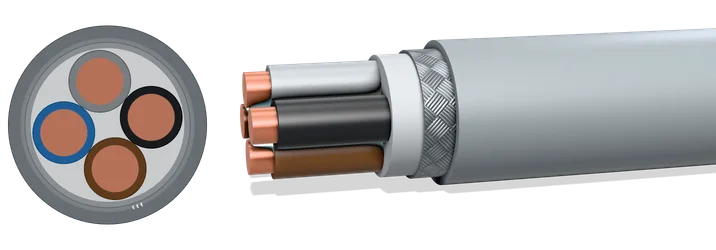
VO-YMvKas Dca
Braid-armoured installation cable 0.6/1 kV, Cu/XLPE/PVC/GSWB/PVC, 90 °C
Lead time: 1–2 working days from stock
In stock: 2×2.5 · 2×4 · 2×6 · 3×2.5 · 3×6 +3
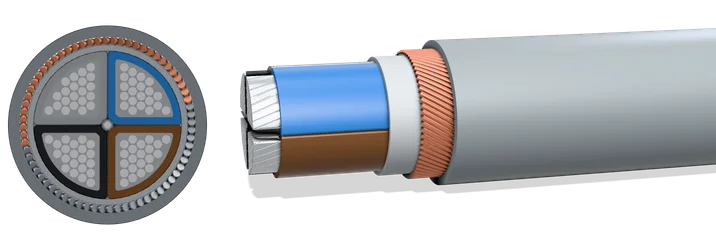
VG-YMvKas Dca ALU
Power cable 0.6/1 kV, aluminium conductor, armoured
Lead time: On request; the lead time is stated in the quote.
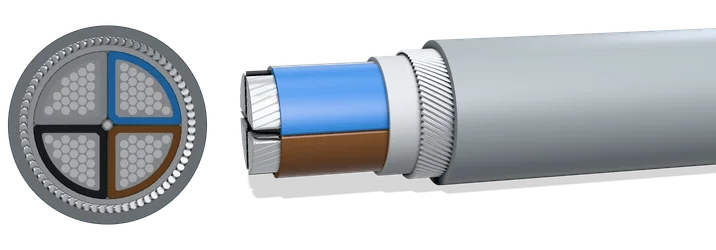
VG-YMvKas AL/AL Cca
Dutch armoured aluminium power cable, aluminium wire armour, 0.6/1 kV
Lead time: On request; the lead time is stated in the quote.
Not seeing what you need? Just ask. Our range goes well beyond this list. Ask us →