
Knowledge
Copper or aluminium conductors
What the choice changes in cross-section, weight, price and joints.
Copper conducts 1.64 times better than aluminium. Aluminium therefore needs over one and a half times the cross-section, but the conductor still weighs only about half as much and costs considerably less per metre. Choose aluminium for large cross-sections and long routes with skilled jointing, copper for confined space, small cross-sections and many termination points.
Copper conducts better than aluminium. The resistivity of copper is about 0.0172 Ω·mm²/m, whereas that of aluminium is 0.0282. That is a factor of 1.64. To reach the same resistance with aluminium you therefore need over one and a half times the cross-section. In practice that is one or two steps up the range.
You see it in the conductor standard. IEC 60228 fixes the resistance per cross-section: copper 95 mm² class 2 comes to 0.193 Ω/km, aluminium 95 mm² to 0.320 Ω/km. Only at 150 mm² aluminium are you back near the copper 95: 0.206 Ω/km. Current rating shifts the same way. Going from copper to aluminium almost always means one or two sizes up.
Weight moves the other way. Aluminium has roughly a third of the density of copper: 2.70 against 8.96 g/cm³. The conductor alone already differs sharply: 95 mm² of copper weighs about 850 kg per kilometre, the same cross-section in aluminium about 255. Over the whole cable the gap narrows. Insulation, screen and sheath weigh the same on both; our NA2XS(F)Y 1×95/16 at 12/20 kV comes to 1,216 kg/km. It shows in drum weight, pulling force and crane time. And because more metres fit on a drum at the same weight, a long route sometimes needs one joint fewer.
The price difference is structural. Copper trades on the LME per tonne at a multiple of aluminium, and on medium voltage cable the conductor is a large part of the cost. That is why network operators lay aluminium as standard over long distances: NA2XS(F)2Y and NA2XS(F)Y are the workhorses there. Copper, N2XS(F)2Y, comes in where trench or duct space is tight, or where there are many termination points.
The real difference is in the joint. Aluminium forms an oxide skin in air at once, and that skin conducts poorly. It also creeps under constant clamping force, so a connection that is tight today can loosen over time. Connecting aluminium therefore calls for cleaning and greasing the contact face, connectors approved for aluminium, the right tightening torque and bimetallic transitions wherever aluminium meets copper busbars or clamps. Put copper straight onto aluminium and you get galvanic corrosion as soon as moisture is present.
So the trade-off is usually clear-cut. Aluminium wins on large cross-sections and long routes, where weight and the copper price dominate and joints are made by trained crews. Copper wins in confined space, on smaller cross-sections, at higher current per mm² and with many termination points. The same choice runs through the low-voltage range: VG-YMvKas Dca ALU sits alongside the copper YMvK and YMvKas types.
For the buyer: compare copper and aluminium on resistance per kilometre, not on cross-section, or you are putting two cables side by side that do not do the same job. An aluminium 150 mm² at 0.206 Ω/km sits where a copper 95 mm² at 0.193 Ω/km sits. On long routes, ask for both versions in one enquiry, each with the cross-section that metal needs, so you can compare the price difference and drum weight at a glance. Allow for connectors approved for aluminium as well, because they are not part of the cable price.
Is there a long route where the copper price is a major cost factor? Send the length, the load and the space in the trench or duct. We put copper and aluminium side by side, each with the cross-section and drum weight that go with it.
In our cable selector, Cross-section tab.
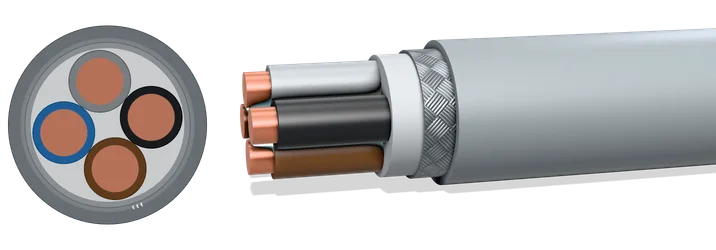
VO-YMvKas Dca
Braid-armoured installation cable 0.6/1 kV, Cu/XLPE/PVC/GSWB/PVC, 90 °C
Lead time: 1–2 working days from stock
In stock: 2×2.5 · 2×4 · 2×6 · 3×2.5 · 3×6 +3
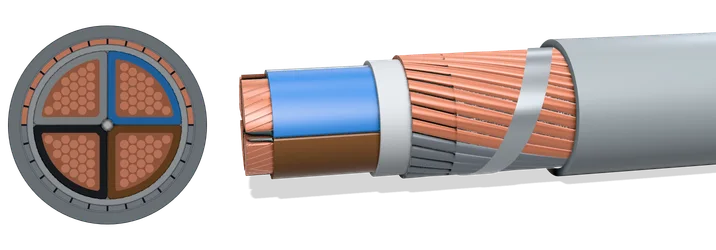
VG-YMvKas Dca
Power cable 0.6/1 kV, XLPE, steel wire armoured
Lead time: 1–2 working days from stock
In stock: 2×10 · 2×16 · 3×10 · 3×16 · 4×10 +9
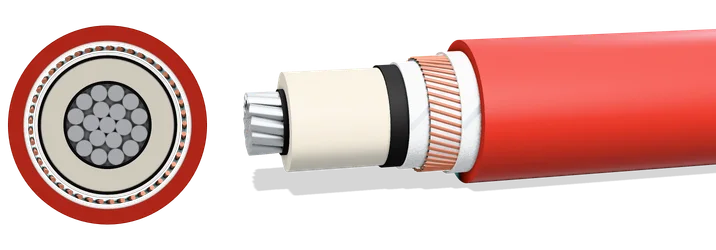
NA2XS(F)Y
Single-core aluminium XLPE MV cable, copper wire screen, longitudinally watertight, PVC sheath, 6/10 to 18/30 kV
Lead time: On request; the lead time is stated in the quote.