
Knowledge
Instrumentation cable: PiMF, TiMF and screening
When individual screening pays off and when a collective screen is enough.
PiMF and TiMF give each pair or triad of an instrumentation cable its own foil screen, on top of the collective screen. That suppresses crosstalk between pairs, which a collective screen cannot do. Analogue next to digital, or simply many pairs in one sheath, therefore calls for PiMF or TiMF. Earth the screen as the instrument manufacturer prescribes: usually at one end for analogue signals, at both ends for fast buses.
PiMF stands for pair in metal foil: each pair has its own aluminium/polyester foil with a tinned copper drain wire. TiMF is the same principle per triad of three cores, common with three-wire Pt100 measurements and other three-wire signals.
A collective screen around the whole core keeps out interference from outside. Individual screens do something a collective screen cannot: suppress crosstalk between the cable’s own pairs. With millivolt measurement signals running next to switching power circuits, that is the difference between a stable and a noisy reading.
When do you need them? Analogue next to digital in one sheath, or simply a lot of pairs together: then PiMF or TiMF is the right call. A few pairs well away from power need only a collective screen, as on an RE-2Y(St)Y with two pairs.
A screen only works when it is earthed, and how depends on the signal. For analogue measurement signals such as 4–20 mA, thermocouples and Pt100, the usual practice is to earth the screen at one end, normally in the cabinet, so no earth current flows through the screen. For fast digital buses and high-frequency interference, earthing at both ends works better, provided the equipotential bonding between the cabinets is in order. Follow what the instrument or bus manufacturer prescribes; they know what their input is sensitive to.
For the buyer: PiMF and TiMF are separate versions, each with its own datasheet. Put "PiMF" or "TiMF" on the enquiry line exactly as written, with the number of pairs or triads and the cross-section per core. Together those two set the outer diameter, and with it how much fits on a drum.
Does a millivolt signal run past a drive or switching power on your site? Describe the route and the signals in it. We will tell you which screening arrangement fits and how to earth it.
In our cable selector, Cable selector tab.
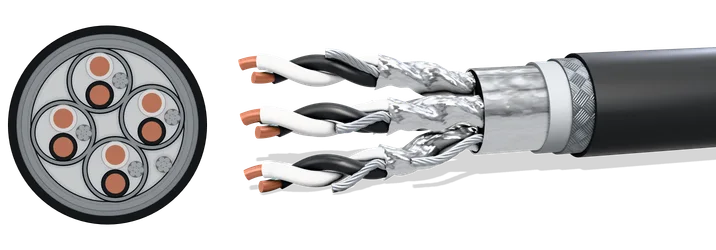
RE-2X(St)YSWBY
EN 50288-7 instrumentation cable, XLPE/PVC, collective, PiMF or TiMF screen, braid armoured
Lead time: 1–2 working days from stock
In stock: 4×2×1.3
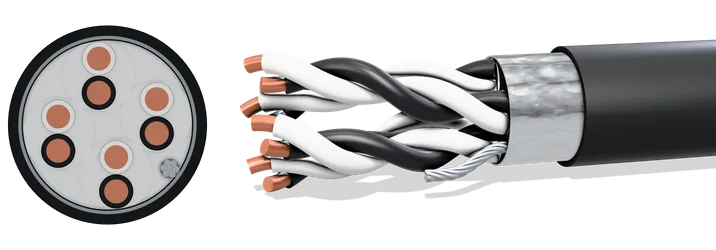
RE-2X(St)H
EN 50288-7 instrumentation cable, XLPE/LSZH, collective screen
Lead time: On request; the lead time is stated in the quote.
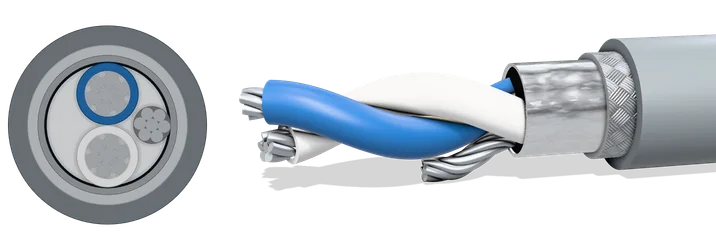
RS-485 1×2×0.20 LSZH
RS-485 bus cable, 1 pair 0.20 mm², 120 Ω, foil and tinned-copper braid, LSZH sheath
Lead time: On request; the lead time is stated in the quote.