
Knowledge
Fire resistant or flame retardant: what is the difference?
Four properties that get mixed up in specifications: flame retardant, fire resistant, halogen-free and the CPR class.
Flame retardant (IEC 60332) means a cable does not propagate the flame and extinguishes once the fire source is removed. Fire resistant means the circuit keeps working during a fire, expressed as a PH class (EN 50200), FE180 (IEC 60331), E30 to E90 (DIN 4102-12), a BS 6387 category or IEC 60331-21 (offshore, NEK 606). Almost every installation cable is flame retardant; only special types such as AS+, FE180, BS 7846 and BFOU are fire resistant.
English specifications often list "flame retardant", "fire retardant" and "fire resistant" side by side as if they meant the same thing. They do not. Flame retardant describes how a cable behaves when it catches fire itself. Fire resistant describes whether it keeps working while there is a fire. The first protects the surroundings, the second keeps an installation running.
Flame retardant is tested to IEC 60332-1-2 for a single cable and IEC 60332-3 for bunched cables: the flame must not propagate along the cable and must go out once the source is removed. Almost all fixed installation cable meets this, such as YMvK to EN 60332-3-24 category C. Note how this differs from the CPR: a rubber cable like H07BQ-F is flame retardant to IEC 60332-1-2, but as a flexible connection cable for mobile use it falls outside EN 50575 and therefore carries no CPR class.
Fire resistant is a different property. Such a cable maintains circuit integrity while exposed to fire. The designation states for how long, and designations differ per standard and per country. EN 50200 gives PH classes in minutes (PH15 to PH120), widely used on Spanish AS+ types and in British specifications. British specifications also ask for categories C, W and Z of BS 6387 or F120 of BS 8491. The German designations, often asked for in the Netherlands, are FE180 to IEC 60331 or VDE 0472-814 (the cable itself survives 180 minutes) and E30, E60 or E90 to DIN 4102-12 (the complete system, brackets and tray included, keeps working for 30, 60 or 90 minutes). A requirement such as E90 therefore says something about the fixing, not just about the cable. Offshore and on board there is one more system: circuit integrity to IEC 60331-21, recognisable in NEK 606 by the B at the front of the type, such as BFOU and BU. The R types, RFOU and RU, are flame retardant only.
The construction is similar in all these cases: a mica-glass tape around the conductor keeps the cores separated after the insulation has burned away. RHOZ1MZ1-K(AS+) and ROZ1MZ1-K(AS+) reach up to PH120 this way. NHXH FE180 and JE-H(St)H Bd FE180 achieve FE180, with E30 to E90 in the right fixing system. BS 7846 achieves C, W and Z, and in the F120 version 120 minutes to BS 8491. BFOU and BU achieve circuit integrity to IEC 60331-21.
Halogen-free (LSZH) is separate again and concerns what is released in a fire: no halogen, little smoke and low acidity, tested to EN 60754 and EN 61034. A halogen-free cable is not automatically fire resistant. A fire resistant cable is usually halogen-free. The CPR class (Aca to Fca) bundles the reaction to fire of a permanently installed cable into one class, but says nothing about circuit integrity.
What does that mean for a specification? If it asks for "flame retardant", a flame retardant cable such as YMvK or RZ1MZ1-K(AS) suffices. If it says "fire resistant", "circuit integrity", a PH class, FE180, E30 to E90, a BS 6387 category or IEC 60331-21, you need a fire resistant cable. Which one depends on the standard it names: an AS+ type, an FE180 type, a BS 7846 or, offshore, a BFOU to NEK 606. Emergency lighting, smoke extraction, fire alarm systems and fire pumps fall into that second group.
Does the specification name a PH class, FE180, E90 or a BS 6387 category? Send that line. We state per type which of the two properties it has and which it does not.
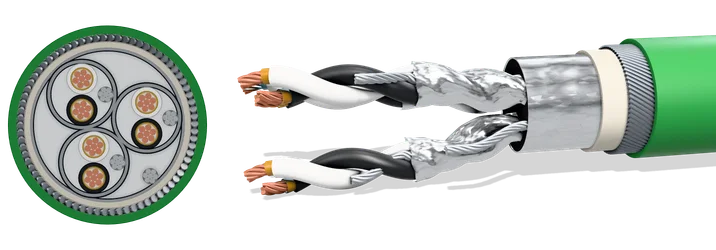
RHOZ1MZ1-K(AS+)
Instrumentation cable 300/500 V, mica/XLPE, individual & collective screen, fire-resistant
Lead time: On request; the lead time is stated in the quote.
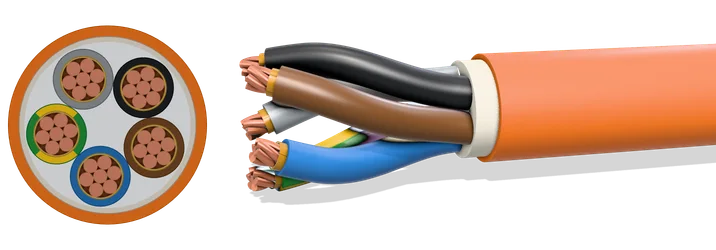
NHXH FE180
Halogen-free fire-resistant power cable, 0.6/1 kV, FE180 E30–E90
Lead time: On request; the lead time is stated in the quote.
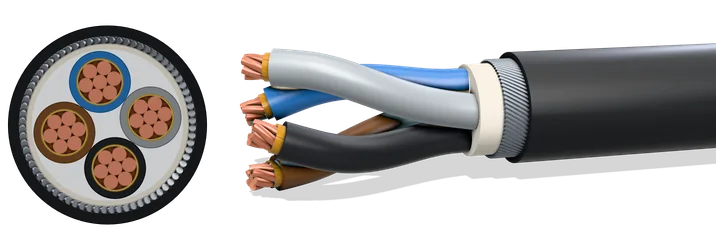
BS 7846
Fire-resistant XLPE/SWA/LSZH armoured power cable, 600/1000 V
Lead time: On request; the lead time is stated in the quote.