Knowledge
Cca, Dca or B2ca: which CPR class for your project
What the classes mean, which one the Bbl requires and what the choice does to price and lead time.
Dca and Cca are reaction-to-fire classes under EN 50575: Dca means a limited contribution to the fire, Cca a smaller one. B2ca is one step higher still and is the requirement in an extra protected escape route. Which class you need is set by the Bbl (article 4.45a, table 4.42), per building use and per type of space; in an extra protected escape route the requirement is highest. Where the Bbl calls for Dca, YMvK Cca from stock complies as well. Halogen-free is a separate requirement, because Cca need not be halogen-free.
Dca and Cca are both reaction-to-fire classes under EN 50575, and they sit one step apart. Dca means a limited contribution to the fire, Cca a smaller contribution, with stricter requirements on heat release and flame spread. A higher main class is allowed, provided the smoke class fits as well. Where the Bbl calls for Dca, it also requires at least smoke class s2: a Cca cable with s1 or s2 therefore complies there too, but a Cca cable with s3 does not. A lower main class is never allowed. If the specification also lists subclasses, compare those separately: Cca-s2,d2,a3 does not meet Dca-s2,d2,a1.
B2ca is the class above Cca: an even smaller contribution to the fire. Where the Bbl requires B2ca is explained further on. B2ca cable is almost always halogen-free. We supply B2ca versions, such as our RS-485 bus cables in B2ca, and for many types a B2ca version is available on request.
The full range runs from Aca to Fca. Aca contributes virtually nothing to a fire; then follow B1ca, B2ca, Cca, Dca and Eca. Fca means no performance has been determined, or that the cable does not meet the Eca requirement. Cca and Dca are the two that turn up most often in Dutch specifications. The class belongs to the cable construction, not to the project: a type either achieves Cca or it does not.
Three subclasses follow the main class: s for smoke production (s1, with the stricter variants s1a and s1b, up to s3), d for flaming droplets (d0 to d2) and a for the acidity of the smoke gases (a1 to a3). So Dca-s1,d2,a2 reads as: limited contribution to the fire, little smoke, possible flaming droplets and moderately acidic smoke gases. From B1ca to Dca the subclasses are always included; for Eca and Fca they are not determined. Watch them when comparing quotations, because Cca-s1,d2,a2 is not the same as Cca-s1,d1,a1.
Which class your project needs is set by the Besluit bouwwerken leefomgeving (Bbl, successor to the Bouwbesluit): article 4.45a and table 4.42 give a minimum fire and smoke class to NEN-EN 13501-6 per building use and per type of space. That requirement applies only where the cable is exposed to indoor or outdoor air. If the cable is embedded in concrete, it falls outside article 4.45a and Eca is enough. NEN 1010 refers to the Bbl; NEN 8012-1 (2023) turns the table into a selection scheme per space. The strictest is the extra protected escape route: there the Bbl requires B2ca with smoke class s1 in every building. On an ordinary protected escape route it depends on the building. In residential blocks, hotels and hospitals, among others, that is B2ca. In offices, shops and schools Dca is enough, as it is in most other spaces.
Halogen-free is not a CPR class, and Cca is not automatically halogen-free. YMvK Cca achieves the class with a PVC sheath. If you need halogen-free and low-smoke, put that in the specification separately. That requirement usually goes together with s1 and a1 in the subclasses, and it leads you to LSZH constructions such as RZ1MZ1-K(AS) and YMz1K.
What does that mean for delivery? YMvK Cca is in stock in Dordrecht and also complies where the Bbl calls for Dca. We supply VO- and VG-YMvKas from stock in Dca. Halogen-free Cca and B2ca constructions are usually supplied to order; the exception is the H07Z1-K earthing conductor, which we hold in stock.
For the buyer: the CPR class affects both the price and the lead time. Above Dca you often end up at a different type, and halogen-free usually means supply to order rather than from stock. So put the class on the enquiry line with the subclasses in full, "Cca-s1b,d1,a1" rather than just "Cca", and say whether halogen-free is a separate requirement. We can then tell you straight away whether it is available from stock.
The class is printed on the cable and stated in the manufacturer’s declaration of performance (DoP). When the project calls for it, we supply the DoP for the project file. Send the specification with your enquiry and we check the type, and flag it when another class is mandatory or more readily available.
Is the class not yet settled? Send the building use, the type of space and the cable you have in mind. We check what table 4.42 of the Bbl requires there and whether that type meets it. Our advice is an aid; the responsible designer or installer checks it and makes the decision.
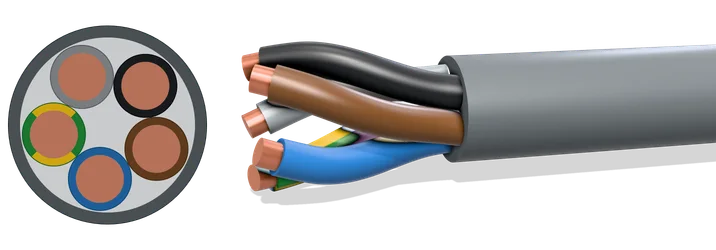
YMvK Cca
XLPE insulated, PVC sheathed installation cable 0.6/1 kV
Lead time: 1–2 working days from stock
In stock: 3G2.5 · 4G2.5 · 5G2.5 · 5G4 · 5G6 +1
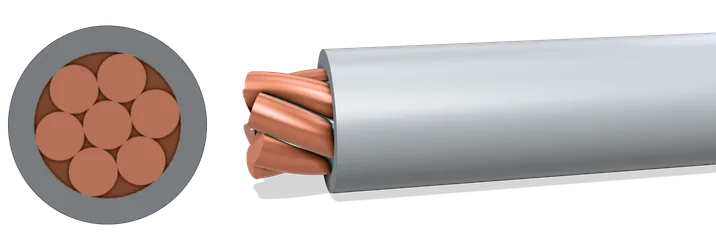
H07V-R
PVC insulated stranded wire, 450/750 V
Lead time: 1–2 working days from stock
In stock: 50 · 70 · 95 · 120 mm²
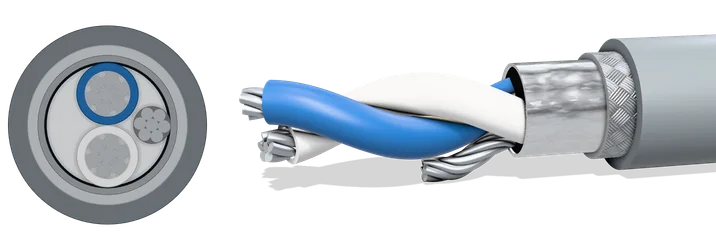
RS-485 1×2×0.20 LSZH
RS-485 bus cable, 1 pair 0.20 mm², 120 Ω, foil and tinned-copper braid, LSZH sheath
Lead time: On request; the lead time is stated in the quote.