
Knowledge
Which cable cross-section do I choose?
Four steps from design current to cross-section, and why voltage drop usually decides.
First determine the design current, then the current rating for the installation method with correction factors, then the voltage drop over the route length (usually 3 to 5 percent). That leaves the short-circuit withstand. The largest cross-section from those four steps is the cable. Our cable selector gives an indicative calculation of voltage drop and current rating. Our advice is an aid; the responsible designer or installer checks it and makes the decision.
You do not choose a cross-section by feel, nor by copying the previous cable. Four steps, in this order: design current, current rating, voltage drop and short-circuit withstand. The largest cross-section that comes out of those steps is the cable.
The design current is step 1. For a three-phase load of 40 kW at 400 V with cos φ 0.9 that is 40,000 / (√3 × 400 × 0.9), over 64 A. Calculate with the actual load, not just the nominal rating of the protective device.
Then the current rating. The datasheet gives the permissible current per installation method: in the ground, in air or in conduit, for a single circuit. On top of that come correction factors for ambient temperature and grouping from NEN 1010 and VDE 0298-4. Six grouped circuits in air nearly halve the rating.
Step 3, voltage drop, is the one that most often decides the size. A second example: a copper XLPE cable such as YMvK carries 63 A three-phase over 80 metres, at cos φ 0.9. In 10 mm² on a wall or in a tray (installation method C), that cable still passes on current rating, but the voltage drop at operating temperature rises to over 4.5 percent. With a 3 percent limit it becomes 16 mm². On long routes this is almost always the step that sets the cross-section.
That leaves the short-circuit withstand: can the cable carry the fault current until the protection trips? On short routes with high-rated protection, this step occasionally still calls for the next size up. For medium voltage, the screen cross-section counts as well.
The Cross-section tab of our cable selector estimates steps 1 to 3 and shows the assumptions. For the specification we verify the result with the quote, including the choice between copper and aluminium and the drum lengths. Our advice is an aid; the responsible designer or installer checks it and makes the decision.
Have you been through the four steps and want the result checked? Send load, length, voltage and installation method. You get type, cross-section, price and lead time back.
In our cable selector, Cross-section tab.
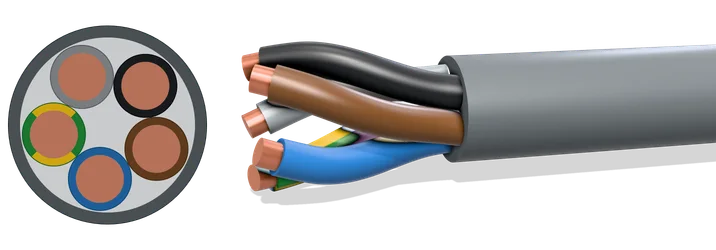
YMvK Cca
XLPE insulated, PVC sheathed installation cable 0.6/1 kV
Lead time: 1–2 working days from stock
In stock: 3G2.5 · 4G2.5 · 5G2.5 · 5G4 · 5G6 +1
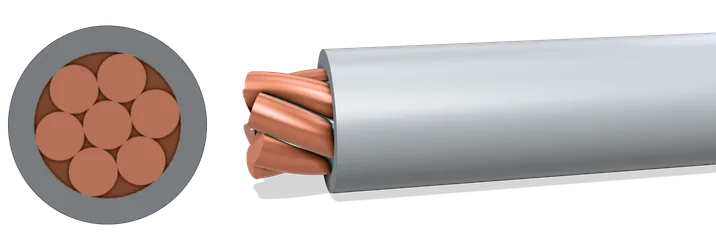
H07V-R
PVC insulated stranded wire, 450/750 V
Lead time: 1–2 working days from stock
In stock: 50 · 70 · 95 · 120 mm²
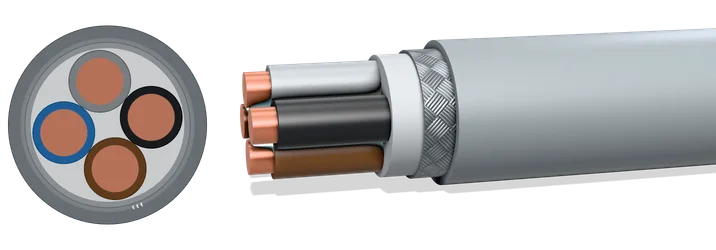
VO-YMvKas Dca
Braid-armoured installation cable 0.6/1 kV, Cu/XLPE/PVC/GSWB/PVC, 90 °C
Lead time: 1–2 working days from stock
In stock: 2×2.5 · 2×4 · 2×6 · 3×2.5 · 3×6 +3