
Knowledge
Current rating and installation method
Why the same cable has different ratings in the ground and in air.
The permissible current of a cable is limited by the conductor temperature, not by cross-section alone. That is why datasheets give separate values for one circuit in the ground and in air. For grouping, temperature and soil, correction factors from NEN 1010 and VDE 0298-4 apply. On long routes, voltage drop rather than current rating usually decides the cross-section.
The current a cable can carry is limited by conductor temperature, not by cross-section alone. How quickly the heat can escape determines the permissible load. And that differs per installation method.
The datasheets therefore give separate columns for a single circuit installed in the ground and in air. According to NEN 1010, a YMvK 1×95 carries about 330 A in free air and about 225 A buried directly in the ground. Grouped, the rating is lower: cables lying against each other trap each other’s heat.
Correction factors then adjust the table values for soil temperature and soil thermal resistivity, ambient temperature, the number of parallel circuits and installation in conduit or tray. NEN 1010 and VDE 0298-4 provide those factors, and they can reduce the permissible current considerably.
Besides the load, voltage drop over the length and the short-circuit withstand of the circuit often decide the final cross-section. On long routes the cable is usually sized on voltage drop, not on current.
For the buyer: a cross-section means little without the installation method. For the same YMvK 1×95 the difference between air and ground is already about 100 A. Grouped, the rating drops further. So put on the enquiry line how the cable will be installed (in the ground, in a tray, in conduit or free in air) and how many circuits run alongside. Otherwise you get a price for a cable that is right on paper but runs too hot in service.
Will the cable run grouped, in conduit or through a warm space? Send load, length and those conditions. We apply the correction factors from NEN 1010 and VDE 0298-4 to the tabulated value. Our advice is an aid; the responsible designer or installer checks it and makes the decision.
In our cable selector, Cross-section tab.
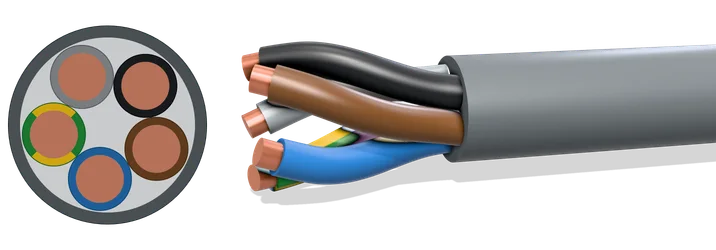
YMvK Cca
XLPE insulated, PVC sheathed installation cable 0.6/1 kV
Lead time: 1–2 working days from stock
In stock: 3G2.5 · 4G2.5 · 5G2.5 · 5G4 · 5G6 +1
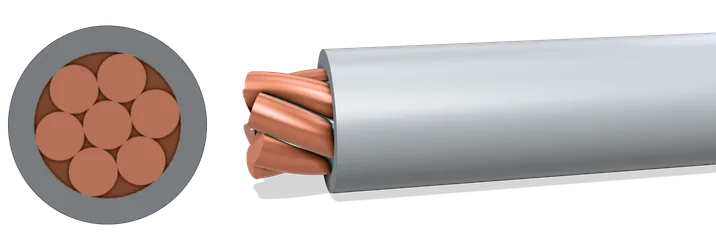
H07V-R
PVC insulated stranded wire, 450/750 V
Lead time: 1–2 working days from stock
In stock: 50 · 70 · 95 · 120 mm²
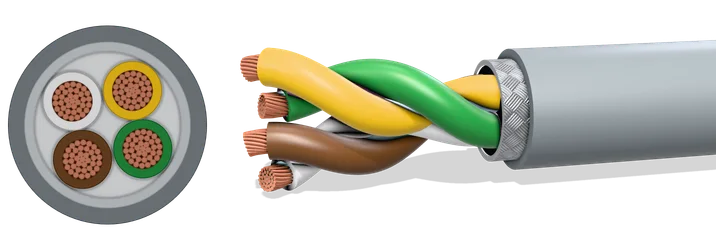
LiHCH-TP
LSZH flexible data cable, twisted pairs, screened
Lead time: 1–2 working days from stock
In stock: 6×2×0.5