
J-Y(St)Y
Telephone & signalling installation cable, DIN VDE 0815, 300 V
J-Y(St)Y is the classic screened telephone and signal cable: solid cores per pair, a collective foil screen and a PVC sheath. For signalling and simple control circuits in buildings. Supplied to order; the lead time is stated in the quote.
J-Y(St)Y (Lg) is a German indoor telephone, signalling and measuring cable ('Fernmeldeleitung') to DIN VDE 0815 for fixed installation in dry and damp rooms inside buildings. Solid bare-copper conductors, specified by diameter (0.6 mm or 0.8 mm), are insulated with PVC and stranded into pairs; the assembled pairs are enclosed by a collective (overall) electrostatic screen (St) of plastic-coated aluminium/polyester foil in contact with a tinned copper drain wire, which protects the signal pairs against electromagnetic interference. A flame-retardant PVC outer sheath (grey) completes the cable. It is used for telephone extensions, signal and data transmission, bell/intercom and low-voltage measuring circuits; it is not intended for power distribution.
Also known as: telephone cable · signal cable
Applications
- Telephone, intercom and signalling installations in buildings.
- Alarm and simple low-power control circuits, not on mains voltage.
What to look out for
- J-Y(St)Y is a telephone and signal cable to VDE 0815. For 24 V control with a higher current, choose LiYCY.
- For industrial electronics at lower voltage choose JE-Y(St)Y.
- CPR class Eca. Where the cable is installed permanently in a building and exposed to indoor air, the Bbl requires at least Dca. The wiring inside a control panel or machine is not covered by that requirement, but the cables running to it are.
- Conductor
- Solid bare (plain) annealed copper, 0.6 mm or 0.8 mm diameter, class 1 acc. to IEC 60228 / DIN VDE 0815.
- Insulation
- PVC core insulation (compound YI1 acc. to DIN VDE 0207-4).
- Stranding
- Cores stranded to pairs (the 2-pair sizes 2×2×0.6 and 2×2×0.8 as a star quad); pairs stranded in layers, colour-coded and numbered.
- Screen
- (St) Collective (overall) electrostatic screen of plastic-coated aluminium/polyester (Al/PET) foil in contact with a tinned copper drain wire (CAM).
- Sheath
- Flame-retardant PVC outer sheath (compound YM1 acc. to DIN VDE 0207-5); grey.
- Peak operating voltage
- 300 V (0.6 mm and 0.8 mm; not for power distribution).
- Test voltage
- 800 V AC core/core and core/screen (50 Hz).
- Standard
- DIN VDE 0815 (telecom/installation cables); conductors acc. to IEC 60228 class 1; flame test IEC 60332-1-2 / DIN VDE 0482-332-1-2.
- Conductor resistance
- 0.8 mm: max. 36.6 Ω/km (loop max. 73.2 Ω/km); 0.6 mm: max. 65 Ω/km (loop max. 130 Ω/km) at 20 °C.
- Mutual capacitance
- max. 100 nF/km at 800 Hz.
- Capacitance unbalance
- Max. 300 pF/100 m (k1).
- Insulation resistance
- min. 100 MΩ × km.
- Max. conductor temperature
- +70 °C (fixed installation).
- Permitted temperature
- Fixed −30 °C to +70 °C; flexing −5 °C to +50 °C.
- Min. bending radius, fixed
- 7.5 × outer diameter.
J-Y(St)Y or JE-Y(St)Y?
J-Y(St)Y
- for buildings
- 300 V
- tested at 800 V
JE-Y(St)Y
- for industrial electronics
- 225 V
- tested at 2,000 V core/screen
Both have solid cores in pairs under a foil screen with a drain wire and a PVC sheath. J-Y(St)Y is the telephone and signal cable for buildings, rated 300 V and tested at 800 V. JE-Y(St)Y is made for industrial electronics: 225 V, and tested at 2,000 V between core and screen. Choose J-Y(St)Y for telephony, intercom and alarm circuits, and JE-Y(St)Y for measuring and control signals in industry.
View JE-Y(St)Y →J-Y(St)Y or the KNX bus cable?
J-Y(St)Y
- tested at 800 V
- not to the KNX specification
KNX bus cable
- tested at 4 kV
- to the KNX specification
The KNX bus cable is based on J-Y(St)Yh 2×2×0.8, but is made to the KNX specification, tested at 4 kV and recognisable by its green sheath. An ordinary J-Y(St)Y is tested at 800 V. So for a KNX bus, choose the bus cable to the KNX specification; J-Y(St)Y remains the cable for telephony, intercom and signalling.
View KNX/EIB bus cable →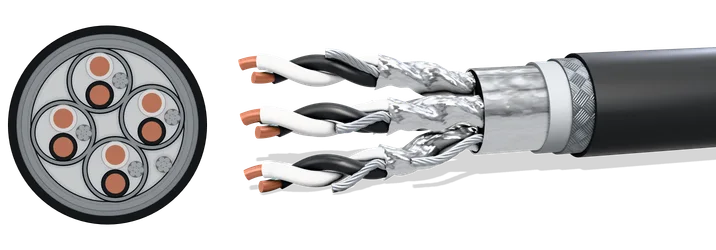
RE-2X(St)YSWBY
EN 50288-7 instrumentation cable, XLPE/PVC, collective, PiMF or TiMF screen, braid armoured
Lead time: 1–2 working days from stock
In stock: 4×2×1.3
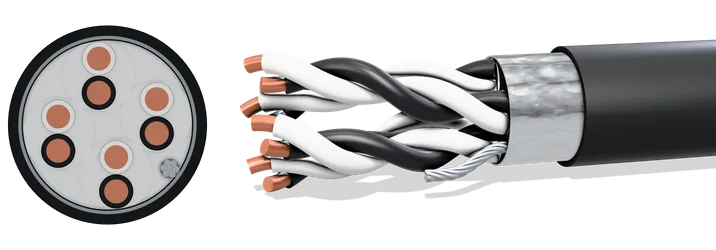
RE-2X(St)H
EN 50288-7 instrumentation cable, XLPE/LSZH, collective screen
Lead time: On request; the lead time is stated in the quote.
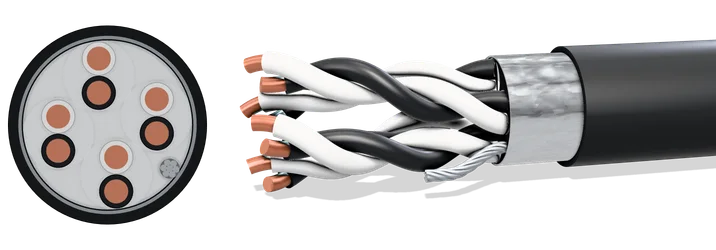
RE-2X(St)Y
EN 50288-7 instrumentation cable, XLPE/PVC, collective screen
Lead time: On request; the lead time is stated in the quote.
Not seeing what you need? Just ask. Our range goes well beyond this list. Ask us →