VG-YMvKas AL/AL Cca
Dutch armoured aluminium power cable, aluminium wire armour, 0.6/1 kV
VG-YMvKas AL/AL is the armoured aluminium YMvKas for 0.6/1 kV: aluminium conductor and aluminium wire armour, which is also the earth conductor. XLPE insulation, CPR class Cca. Supplied to order; the lead time is stated in the quote.
VG-YMvKas AL/AL is a Dutch armoured installation and distribution power cable for 0.6/1 kV, for fixed installation indoors, in cable ducts and trays and for direct burial where both mechanical and electrical protection are required. The sector-shaped aluminium conductors are insulated with cross-linked polyethylene (XLPE), laid up and bedded with a flame-retardant polyvinyl chloride (PVC) inner sheath, and protected by a layer of round aluminium wires (armour); a grey flame-retardant PVC outer sheath completes the cable. VG is the armoured version; AL/AL denotes the aluminium conductor combined with aluminium-wire armour, which also serves as the earth conductor. With a Cca reaction-to-fire classification the cable is intended for use in buildings and civil works subject to the Construction Products Regulation (CPR). VG distinguishes this round-wire-armoured cable from the braided VO-YMvKas and the tape-armoured VD-YMvKas.
Also known as: aluminium underground cable
Applications
- Armoured aluminium distribution indoors, in ducts, on trays and directly in the ground.
- Long feeders where a light cable counts: aluminium conductor and aluminium armour.
- Buildings and civil works under the CPR.
What to look out for
- Aluminium conductor and aluminium armour: bimetallic lugs for the cores and, for the armour, glands approved for aluminium; clean and grease the contact faces.
- Earth runs through the aluminium wire armour; the cable has no green/yellow core.
- VG, with round aluminium wire armour, is the heavy-duty version for use under paving and where there is a risk of mechanical damage.
- Conductor
- Aluminium, sector-shaped stranded (svs), class 2 acc. to IEC 60228.
- Insulation
- Cross-linked polyethylene (XLPE).
- Bedding / inner sheath
- Flame-retardant polyvinyl chloride (PVC/ST, HD 604 S1), grey.
- Armour
- Round aluminium wires (aluminium wire armour, AWA).
- Outer sheath
- Flame-retardant polyvinyl chloride (PVC/ST, HD 604 S1), grey.
- Core identification
- Coloured cores acc. to NEN / HD 308 S2, without a green/yellow core. Earth via the aluminium wire armour.
- Rated voltage Uo/U
- 0.6/1 kV.
- Test voltage
- 3.5 kV.
- Standard
- Reaction to fire EN 50575 (CPR); construction acc. to HD 604 S1 (:1994/A2:2002/A3:2005); conductor acc. to IEC 60228; approval: TÜV.
- Flame-retardant
- Acc. to IEC/EN 60332-1-2 (consistent with the Cca class).
- Max. conductor temperature
- +90 °C (XLPE).
- Max. short-circuit temperature
- +250 °C (max. 5 s).
- Permitted operating temperature, fixed
- −30 °C to +90 °C (min. 0 °C during installation).
- Min. bending radius, fixed
- 12 × outer diameter.
VG-YMvKas AL/AL or Dca ALU?
VG-YMvKas AL/AL Cca
- round aluminium wires
- earth via aluminium armour
VG-YMvKas Dca ALU
- galvanised steel wire
- copper wire earth conductor (ECC)
The difference is the armour. VG-YMvKas AL/AL has round aluminium wires, which also carry the earth. VG-YMvKas Dca ALU has galvanised steel wire with an earth continuity conductor of copper wires (ECC). On AL/AL both the cores and the earth are aluminium, so the glands must also be suitable for aluminium; if you want to connect the earth to copper, choose the Dca ALU.
View VG-YMvKas Dca ALU →VG-YMvKas AL/AL or NAYY?
VG-YMvKas AL/AL Cca
- armoured
- XLPE insulation, 90 °C
- earth via aluminium armour
NAYY
- unarmoured
- PVC insulation, 70 °C
- green/yellow core in J version
Both have aluminium conductors. VG-YMvKas AL/AL is armoured, has XLPE insulation rated for 90 °C and no green/yellow core: the earth runs through the aluminium wire armour. NAYY is unarmoured, has PVC insulation rated for 70 °C and, in the J version, a green/yellow core. If mechanical protection is needed, choose AL/AL; NAYY suits a German specification, and underground we then advise a sand bed with cover tiles or a duct.
View NAYY →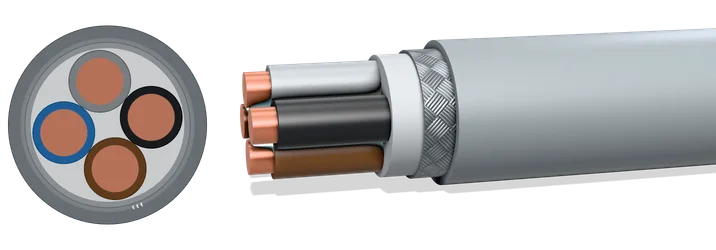
VO-YMvKas Dca
Braid-armoured installation cable 0.6/1 kV, Cu/XLPE/PVC/GSWB/PVC, 90 °C
Lead time: 1–2 working days from stock
In stock: 2×2.5 · 2×4 · 2×6 · 3×2.5 · 3×6 +3
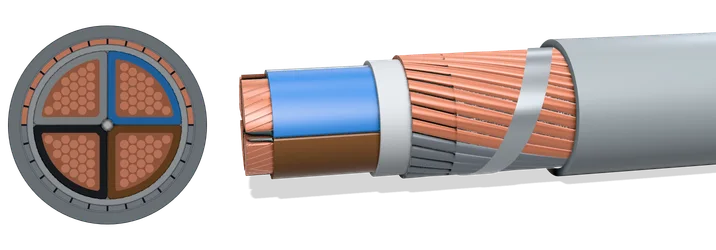
VG-YMvKas Dca
Power cable 0.6/1 kV, XLPE, steel wire armoured
Lead time: 1–2 working days from stock
In stock: 2×10 · 2×16 · 3×10 · 3×16 · 4×10 +9
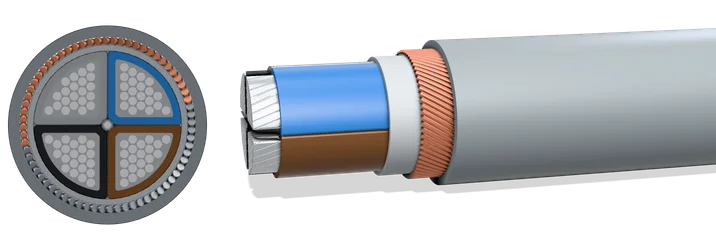
VG-YMvKas Dca ALU
Power cable 0.6/1 kV, aluminium conductor, armoured
Lead time: On request; the lead time is stated in the quote.
Not seeing what you need? Just ask. Our range goes well beyond this list. Ask us →