
Type P instrumentation triads
IEEE 1580 offshore instrumentation cable, individually screened triads, XLPO, unarmoured, B or BS, 0.6/1 kV
Type P instrumentation triads has a screen on every triad: each black, white and red triad is twisted with a tinned drain wire and wrapped in aluminium foil, with an overall screen on top. 0.6/1 kV to IEEE 1580, listed to UL 1309 as Type X110, in 1 to 12 triads of 18 AWG (0.96 mm²) and 1 to 8 of 16 AWG (1.32 mm²). Unarmoured, B or BS. Supplied to order; the lead time is stated in the quote.
Type P instrumentation triads is a flexible offshore and marine instrumentation cable to IEEE 1580, listed to UL 1309 / CSA 245 as Type X110, rated 0.6/1 kV with a conductor temperature of up to +110 °C. Each triad of soft annealed tinned copper conductors with XLPO insulation, in black, white and red, is twisted with a bare tinned drain wire and screened with polyester-backed aluminium foil. The triads are isolated from each other and lie under an overall screen and a black, arctic-grade thermoset sheath. For intrinsically safe circuits a blue sheath or blue stripe is available on request. The cable comes unarmoured, with a bronze basket-weave armour (B), and with that armour plus a thermoset outer sheath that also resists drilling mud (BS). Only the BS version is suitable for Class I Division 1 and Zone 1. The version with pairs is Type P instrumentation pairs.
Also known as: Type P instrumentation cable · IEEE 1580 instrumentation cable
Applications
- Three-wire measuring circuits, such as a three-wire Pt100, on offshore installations.
- Intrinsically safe circuits, with a blue sheath or blue stripe on request.
- Installations designed to IEEE 45, or where the specification calls for Type P.
What to look out for
- Only the BS version is suitable for Class I Division 1 and Zone 1. NEC Article 337 requires fittings listed for the location there. State the version in your enquiry.
- For intrinsically safe circuits a blue sheath or blue stripe is available. State it in your enquiry.
- The datasheet does not state that the sheath is halogen-free. If the specification calls for halogen-free to IEC 60754, choose a NEK 606 type.
- Type P falls outside EN 50575 and so has no CPR class. Where the cable is exposed to indoor air in a building, the Bbl does require a class; choose another cable there.
- Conductor
- Soft annealed, flexible stranded tinned copper acc. to IEEE 1580 Table 11; 19 strands in 18 and 16 AWG.
- Insulation
- Cross-linked, flame-retardant polyolefin (XLPO), acc. to IEEE 1580 Type P and UL 1309 / CSA 245 Type X110.
- Triads
- Each triad twisted with a bare tinned copper drain wire and screened with polyester-backed aluminium foil, 100% coverage. Triads isolated from each other, with an overall screen.
- Core identification
- Each triad black/white/red.
- Sheath
- Black, arctic-grade, flame-retardant thermoset compound, resistant to oil, abrasion, chemicals and sunlight. Blue sheath or blue stripe for intrinsically safe circuits on request.
- Armour (B and BS)
- Basket-weave wire braid of bronze; tinned copper on request.
- Outer sheath (BS)
- Black, arctic-grade, flame-retardant thermoset compound over the armour, resistant to oil, drilling mud, abrasion, chemicals and sunlight. Sheath resistant to ester-based drilling mud acc. to NEK 606 on request.
- Rated voltage Uo/U
- 0.6/1 kV.
- Standard
- IEEE 1580 Type P; UL 1309 / CSA 245 Type X110; conductors acc. to IEEE 1580 Table 11.
- Max. conductor temperature
- +110 °C.
- Classification society ratings
- ABS +100 °C; DNV, Lloyd’s Register and Transport Canada +95 °C.
- Cold resistance
- Passes the CSA cold bend test (−40 °C) and cold impact test (−35 °C).
- Flame-retardant
- Acc. to IEC 60332-3 Category A and IEEE 1202.
- Hazardous areas
- Class I Division 1 and Zone 1 in the armoured and sheathed version (BS) only, terminated with fittings listed for the location (NEC Article 337).
- Approvals
- ABS, DNV, Lloyd’s Register, Transport Canada and United States Coast Guard; UL and CSA listed as marine shipboard cable.
- Reaction to fire (CPR)
- Outside the scope of EN 50575 (offshore and shipboard cable).
- Min. bending radius, unarmoured
- 6 × outer diameter (IEEE 45).
- Min. bending radius, armoured (B and BS)
- 8 × outer diameter (IEEE 45).
Three versions
| Version | Over the cores | Min. bending radius | Class I Div. 1 and Zone 1 |
|---|---|---|---|
| Unarmoured | Thermoset sheath | 6 × outer diameter | No |
| B, armoured | Sheath with the bronze braid as the outer layer | 8 × outer diameter | No |
| BS, armoured and sheathed | Sheath, bronze braid and outer sheath | 8 × outer diameter | Yes, with fittings listed for the location |
Dimensions and weight per version
| Unarmoured | B, armoured | BS, armoured and sheathed | |||||
|---|---|---|---|---|---|---|---|
| Triads × cores × size | Equivalent c.s.a. (mm²) | Ø (mm) | kg/km | Ø (mm) | kg/km | Ø (mm) | kg/km |
| 1 × 3 × 18 AWG | 0.96 | 9.0 | 103 | 10.3 | 238 | 14.1 | 249 |
| 2 × 3 × 18 AWG | 0.96 | 16.5 | 304 | 17.8 | 451 | 22.3 | 640 |
| 3 × 3 × 18 AWG | 0.96 | 17.9 | 351 | 19.1 | 513 | 23.5 | 710 |
| 4 × 3 × 18 AWG | 0.96 | 19.7 | 470 | 21.0 | 592 | 24.8 | 884 |
| 5 × 3 × 18 AWG | 0.96 | 22.6 | 525 | 23.9 | 740 | 28.3 | 979 |
| 7 × 3 × 18 AWG | 0.96 | 24.3 | 686 | 25.6 | 914 | 30.5 | 1,168 |
| 8 × 3 × 18 AWG | 0.96 | 26.0 | 877 | 27.3 | 1,094 | 29.0 | 1,339 |
| 12 × 3 × 18 AWG | 0.96 | 31.0 | 1,179 | 32.3 | 1,473 | 41.7 | 1,778 |
| 1 × 3 × 16 AWG | 1.32 | 9.6 | 121 | 10.8 | 307 | 14.7 | 394 |
| 3 × 3 × 16 AWG | 1.32 | 19.3 | 545 | 20.6 | 612 | 25.9 | 850 |
| 4 × 3 × 16 AWG | 1.32 | 20.8 | 610 | 22.1 | 680 | 25.4 | 961 |
| 6 × 3 × 16 AWG | 1.32 | 24.1 | 935 | 25.4 | 1,177 | 30.4 | 1,524 |
| 7 × 3 × 16 AWG | 1.32 | 26.1 | 780 | 27.4 | 1,024 | 31.7 | 1,527 |
| 8 × 3 × 16 AWG | 1.32 | 28.1 | 1,018 | 29.4 | 1,180 | 33.3 | 1,638 |
Nominal manufacturer values, with a manufacturing tolerance of ±5%. The equivalent c.s.a. per size is the manufacturer’s value for its stranded conductor, not the nominal AWG cross-section (18 AWG: 19 strands of 0.0100 inch, 0.96 mm²; nominal 0.82 mm²). In a few sizes the diameters or weights on the sheet do not rise consistently with the size or the number of triads. We reproduce the values as published.
Electrical values per size
| Size | Equivalent c.s.a. (mm²) | Strands | R 20 °C (Ω/km) | Capacitance (nF/km) | Inductance (mH/km) |
|---|---|---|---|---|---|
| 18 AWG | 0.96 | 19 | 23.7 | 91.9 | 0.722 |
| 16 AWG | 1.32 | 19 | 14.8 | 105.0 | 0.656 |
Triads or pairs?
Type P instrumentation triads
- three conductors per element
- three-wire circuits, such as a Pt100
Type P instrumentation pairs
- two conductors per element
- two-wire circuits
You need a triad for a three-wire circuit, such as a three-wire Pt100, where the third conductor compensates for the lead resistance. For a two-wire circuit, such as a 4–20 mA transmitter or a switch contact, a pair is enough. Construction and versions are otherwise the same.
View Type P instrumentation pairs →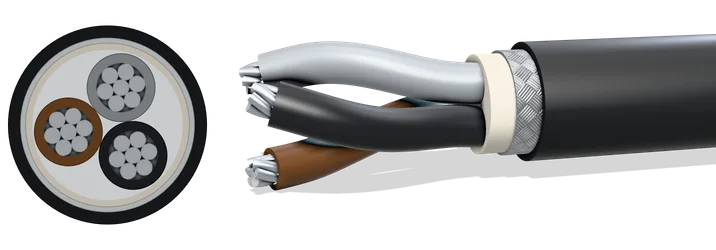
RFOU 0.6/1 kV
NEK 606 offshore power cable, halogen-free, braid armoured
Lead time: On request; the lead time is stated in the quote.
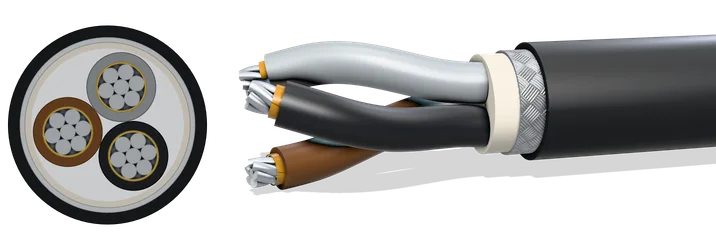
BFOU 0.6/1 kV
NEK 606 offshore fire-resistant power cable, halogen-free, braid armoured
Lead time: On request; the lead time is stated in the quote.
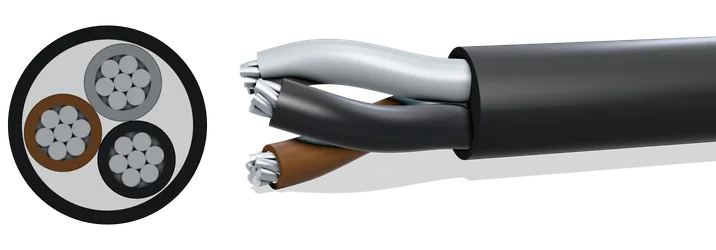
RU 0.6/1 kV
NEK 606 offshore power cable, halogen-free, unarmoured
Lead time: On request; the lead time is stated in the quote.
Not seeing what you need? Just ask. Our range goes well beyond this list. Ask us →