NA2XSEYFGbY
Three-core XLPE medium-voltage power cable, aluminium, flat-steel-wire armoured
NA2XSEYFGbY is the armoured aluminium MV cable: flat steel wire armour (FSWA) under a PVC sheath for mechanical protection when buried directly. In all four voltage classes. Supplied to order; the lead time is stated in the quote.
NA2XSEYFGbY is a three-core, individually screened, cross-linked-polyethylene (XLPE) insulated medium-voltage power cable with aluminium conductors and galvanised flat-steel-wire armour, for industrial and utility distribution networks. Each aluminium conductor carries an extruded semi-conductive conductor screen, XLPE insulation, an extruded semi-conductive insulation screen and an individual copper wire screen; the three screened cores are laid up with fillers, covered by an extruded PVC inner sheath, armoured with galvanised flat steel wires bound by a galvanised steel-tape counter helix, and protected by a PVC outer sheath. The armour provides mechanical protection for direct burial and for installation in ground, ducts, cable trenches and industrial plant where additional protection or high pulling stresses are expected. Available from 6/10 to 18/30 kV to IEC 60502-2, constructed following DIN VDE 0276-620.
Also known as: armoured medium voltage cable
Applications
- Direct burial where mechanical protection is needed or crushing loads occur.
- Long routes where aluminium saves weight and cost.
What to look out for
- Earth the steel wire armour and copper screen at both ends through the termination; the armour is there for tension and pressure, not as the installation earth.
- The copper counterpart is N2XSEYFGbY.
- Conductor
- Stranded compacted circular (RM) aluminium, class 2 acc. to IEC 60228.
- Conductor screen
- Extruded semi-conductive compound.
- Insulation
- Cross-linked polyethylene (XLPE), nominal thickness per voltage class (3.4 mm at 6/10 kV, 4.5 mm at 8.7/15 kV, 5.5 mm at 12/20 kV, 8.0 mm at 18/30 kV).
- Insulation screen
- Extruded semi-conductive compound with a semi-conductive tape.
- Core screen
- Copper wire screen with a copper equalising/counter tape, applied over each core.
- Lay-up
- Three screened cores laid up with fillers and a binder tape.
- Inner sheath
- Extruded polyvinyl chloride (PVC) bedding.
- Armour
- Galvanised flat steel wires (F) with a galvanised steel-tape counter helix (Gb).
- Outer sheath
- Polyvinyl chloride (PVC), black or red (other colours on request).
- Rated voltage Uo/U
- 6/10 (12) to 18/30 (36) kV.
- Test voltage
- 3.5 × Uo for 5 min (routine test acc. to IEC 60502-2): 21 kV at 6/10, 30.5 kV at 8.7/15, 42 kV at 12/20 and 63 kV at 18/30 kV.
- Standard
- IEC 60502-2, constructed following DIN VDE 0276-620; conductors acc. to IEC 60228.
- Flame-retardant
- Acc. to IEC 60332-1-2 (single vertical cable).
- Max. conductor temperature
- +90 °C (normal operation).
- Max. short-circuit temperature
- +250 °C (max. 5 s).
- Min. bending radius, fixed
- 15 × outer diameter.
Voltage classes
| Voltage class Uo/U | Highest voltage Um | Insulation nom. |
|---|---|---|
| 6/10 kV | 12 kV | 3.4 mm |
| 8.7/15 kV | 17.5 kV | 4.5 mm |
| 12/20 kV | 24 kV | 5.5 mm |
| 18/30 kV | 36 kV | 8.0 mm |
NA2XSEYFGbY or three NA2XS(F)2Y?
NA2XSEYFGbY
- one cable, three cores
- flat steel wires
- PVC inner and outer sheath
- 6/10 to 18/30 kV
three × NA2XS(F)2Y
- three separate cables
- unarmoured
- PE sheath, longitudinally watertight
- also 20.8/36 kV
NA2XSEYFGbY is one armoured cable with three screened aluminium cores, a PVC inner sheath, flat steel wires and a PVC outer sheath, from 6/10 to 18/30 kV. Three separate NA2XS(F)2Y cables are unarmoured, but longitudinally watertight with a PE sheath, and also come in 20.8/36 kV. The armour of NA2XSEYFGbY gives mechanical protection when buried directly. For 20.8/36 kV choose three NA2XS(F)2Y.
View NA2XS(F)2Y →NA2XSEYFGbY or N2XSEYFGbY?
NA2XSEYFGbY
- aluminium conductors
- larger cross-section
N2XSEYFGbY
- copper conductors
- smaller cross-section
NA2XSEYFGbY is the aluminium version of N2XSEYFGbY; armour, screens, sheaths and classes are the same. Aluminium is lighter and more economical, which matters most on long routes. For the same current, however, aluminium needs a larger cross-section. If the cable must stay as compact as possible, choose the copper N2XSEYFGbY.
View N2XSEYFGbY →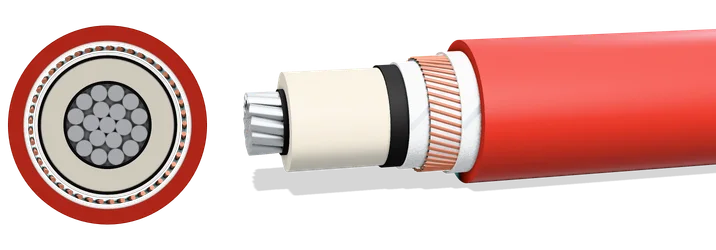
NA2XS(F)Y
Single-core aluminium XLPE MV cable, copper wire screen, longitudinally watertight, PVC sheath, 6/10 to 18/30 kV
Lead time: On request; the lead time is stated in the quote.
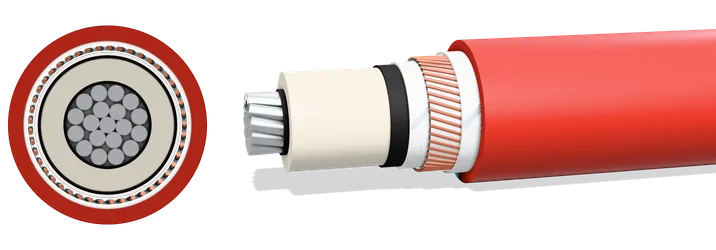
EAXeCWB
Single-core Al XLPE MV cable, Cu wire screen, longitudinally watertight, 8.7/15 to 20.8/36 kV
Lead time: On request; the lead time is stated in the quote.
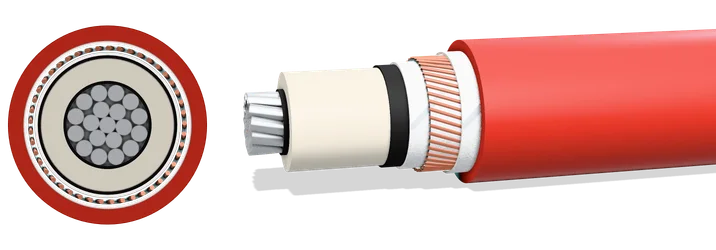
EAXeCGB
Single-core Al XLPE MV cable, Cu wire screen, longitudinally watertight, halogen-free sheath, 8.7/15 to 20.8/36 kV
Lead time: On request; the lead time is stated in the quote.
Not seeing what you need? Just ask. Our range goes well beyond this list. Ask us →