
Cat 5e U/UTP
Category 5e U/UTP LAN installation cable, Class D
Cat 5e U/UTP is the familiar Gigabit LAN cable to 100 MHz: four unscreened pairs, 100 ohm, for office and home networks. Supplied to order; the lead time is stated in the quote.
Cat 5e U/UTP is an unscreened four-pair horizontal LAN cable for structured building cabling and general LAN/network wiring, supporting Class D links to ISO/IEC 11801 and EN 50173 up to 100 MHz. Each conductor is a solid bare copper wire of AWG 24 (nominal 0.51 mm) with solid polyethylene (PE) insulation; two cores are twisted into a pair and four pairs (4×2×AWG 24) are laid up under a PVC outer sheath. Being U/UTP, it has no metallic screen: the balanced twisted pairs alone provide the required transmission performance, which keeps the cable thin, light and easy to terminate. It supports 10BASE-T, 100BASE-TX and 1000BASE-T (Gigabit) Ethernet as well as PoE/PoE+ powering, and is supplied on reels or in pull-boxes for fixed indoor installation in conduit, trunking, floor ducts and cavities. The standard sheath is PVC with a CPR reaction-to-fire class of Eca (Dca on request); a low-smoke halogen-free (LSZH) version with class Dca or B2ca is available. The class required depends on the building use and the type of space (Bbl, table 4.42).
Also known as: network cable · LAN cable · ethernet cable
Applications
- Gigabit Ethernet (1000BASE-T) up to 100 metres in office and home.
- General data outlets and VoIP in light networks.
What to look out for
- Unscreened: keep clear of heavy power cables.
- For 10 Gigabit choose Cat 6A or higher.
- CPR class Eca in PVC. Where the cable is exposed to indoor air in a building, the Bbl requires at least Dca. On request we supply Cat 5e U/UTP in Dca, and halogen-free also in B2ca.
- Conductor
- Solid bare copper, AWG 24 (nominal 0.51 mm).
- Insulation
- Polyethylene (PE).
- Cores
- 4 twisted pairs, 100 Ω, unscreened (U/UTP).
- Sheath
- PVC (LSZH on request).
- CPR classification
- Eca as standard (EN 50575); Dca or B2ca (LSZH) on request.
- Category / class
- Cat 5e / Class D.
- Frequency range
- Up to 100 MHz.
- Characteristic impedance
- 100 Ω.
- Screen
- None (U/UTP).
- Conductor
- 4×2×AWG 24.
Cat 5e or Cat 6?
Cat 5e U/UTP
- Class D, 100 MHz
- AWG 24
- Gigabit, no 10GBASE-T
Cat 6
- Class E, 250 MHz
- AWG 23 with cross separator
- 10GBASE-T up to 55 m
Cat 5e (Class D) is specified up to 100 MHz, Cat 6 (Class E) up to 250 MHz. Cat 6 has thicker conductors (AWG 23 against AWG 24) and a cross separator between the pairs. Both are fine for Gigabit, but only Cat 6 carries 10GBASE-T, up to 55 m. If 10 Gigabit has to run over the full 100 m, it becomes Cat 6A.
View Cat 6 U/UTP →Cat 5e or Cat 6A?
Cat 5e U/UTP
- Class D, 100 MHz
- Gigabit
Cat 6A
- Class EA, 500 MHz
- 10GBASE-T over 100 m
The difference is 10 Gigabit. Cat 6A (Class EA, 500 MHz) carries 10GBASE-T over the full 100 m, while Cat 5e (Class D, 100 MHz) is for Gigabit. Our Cat 6A always has a foil around each pair, so it needs screened connectors and an earthed patch panel. Choose Cat 5e for simple Gigabit networks, and Cat 6A if the network must be able to carry 10 Gigabit.
View Cat 6A U/FTP →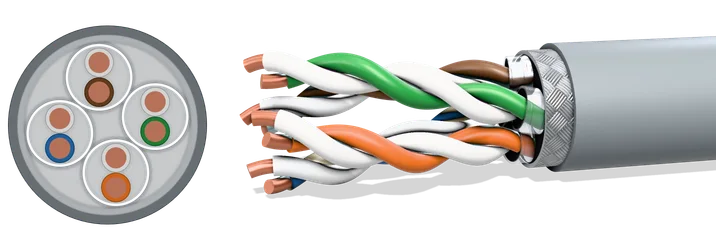
Cat 7 S/FTP
Category 7 installation cable, foiled pairs + overall braid (S/FTP), LSZH
Lead time: 1–2 working days from stock
In stock: 4×2×AWG 23
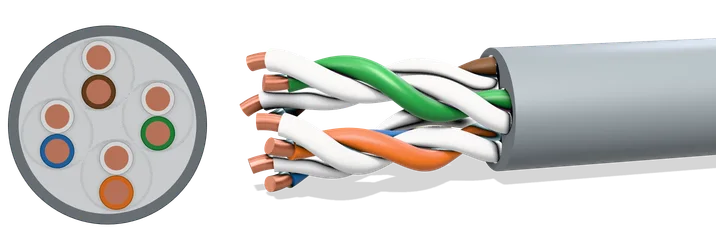
Cat 6 U/UTP
Category 6 U/UTP LAN installation cable, Class E
Lead time: On request; the lead time is stated in the quote.
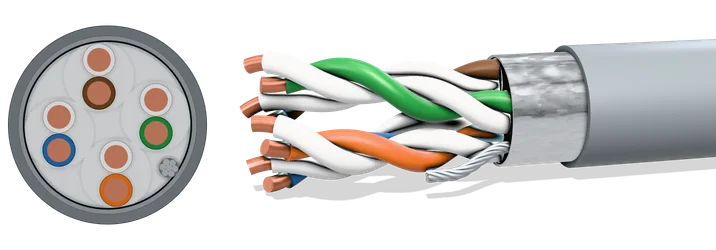
Cat 6 F/UTP
Category 6 F/UTP foil-screened LAN installation cable, Class E
Lead time: On request; the lead time is stated in the quote.
Not seeing what you need? Just ask. Our range goes well beyond this list. Ask us →