
Knowledge
Coax: RG types and MIL-C-17
What an RG number does and does not guarantee.
An RG number is a trade name from an American military nomenclature and on its own says very little about the cable. Only the MIL-C-17 designation, such as M17/74-RG213, determines impedance, dielectric, braid coverage and tolerances. Choose coax by attenuation at the working frequency and by screening effectiveness, and by CPR class for fixed installation.
RG numbers come from an American military nomenclature of the 1940s and survived as trade names. An RG number on its own says little: it is not a protected designation. Only the designation to MIL-C-17 fixes impedance, dielectric, braid coverage and tolerances, for example M17/74-RG213. The latest editions of that American specification are officially called MIL-DTL-17; in practice and on the datasheets it remains MIL-C-17.
The common 50-ohm types differ in size and screening. RG 58 is thin and flexible, for short links and patch leads. RG 213 is thicker, with lower attenuation and a plain copper braid of 93% coverage. The copper braid is the screen of the coax: it keeps interference out and keeps the signal in. The higher the coverage, the better it does both. RG 214 has two silvered braids, of 81 and 85% coverage, and so keeps more out at the same size. RG 223 is thin and double screened, with two silvered braids of 98 and 97%. That high coverage does not make it the better cable: its inner conductor is a single 0.90 mm wire against 7 × 0.75 mm on the RG 213 and RG 214, so attenuation is a good deal higher. All coverage figures come from our own datasheets.
For fixed installation in buildings the CPR applies as well, coax included. Our RG types are classified Eca. Where the cable is installed permanently in a building and exposed to indoor air, the Bbl requires at least Dca; RG59 and RG6 are available on request in a halogen-free version in Dca or B2ca. The TY-ZH and U-ZH versions have a halogen-free, flame-retardant sheath (LSZH), for places where smoke and acid gases matter in a fire. They are Eca as well.
Choose by attenuation at the working frequency and by the required screening effectiveness, not by the RG number alone. The attenuation tables per frequency are in the datasheets.
For the buyer: if the specification names a MIL-C-17 designation, order on that and not on the RG number alone; two cables with the same RG number can have a different braid and a different dielectric. Put the working frequency, the length per link and the connector type on the enquiry line. If the project asks for a halogen-free sheath, say so separately: that is what the TY-ZH and U-ZH versions are for, and like the other RG types they fall in class Eca.
Is it a test setup, an antenna feeder or a fixed run through a building? Send the frequency and the screening effectiveness you need. We will find the right type and tell you whether it carries its own MIL-C-17 designation.
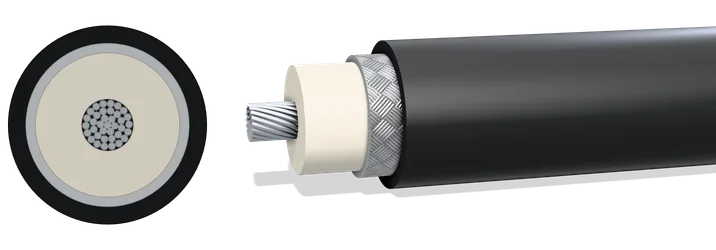
RG 58 CU
50 ohm RF coaxial cable to MIL-C-17
Lead time: On request; the lead time is stated in the quote.
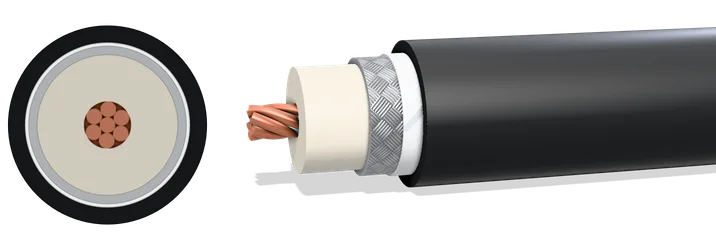
RG 213 TY-ZH
50 ohm RF coaxial cable to MIL-C-17, LSZH
Lead time: On request; the lead time is stated in the quote.