
RG 214 TY-ZH
Double-screened 50 ohm RF coaxial cable to MIL-C-17, LSZH
RG 214 TY-ZH is the double-screened 50 ohm coaxial cable to MIL-C-17 with a halogen-free, flame-retardant (LSZH) sheath: silvered copper inner conductor 7 × 0.75 mm, PE dielectric and two silvered copper braids (81% and 85% coverage). Almost the same size as RG 213 (10.8 against 10.3 mm), but with much higher screening for EMC-sensitive environments.
RG 214 TY-ZH is the halogen-free version of the heavy, double-screened 50 ohm RG 214 coax. It is intended for antenna and transmitter feeders, radar and measurement links that need better screening than a single-braid cable, where smoke and corrosive gases in a fire must be kept to a minimum. The designation follows the RG 214 type of the MIL-C-17 family. The sheath is halogen-free to EN 60754-1/-2 and low-smoke to EN 61034-2. The CPR class is Eca.
Also known as: coax cable · double-screened coax
Applications
- RF links with high screening requirements: test labs, transmitters with several channels side by side.
- Professional RF and radar installations that call for the RG 214 construction, in a halogen-free version.
- Where RG 213 picks up or radiates too much: EMC-sensitive equipment.
What to look out for
- The gain is in the screening, not the attenuation: that is comparable to RG 213 (same dielectric).
- Slightly thicker than RG 213: check the connector size and glands, because the RG 213 crimp ferrule does not always fit.
- Silvered braids: when crimping, get both braids neatly under the ferrule, or you lose the screening you paid for.
- CPR class Eca. Where the cable is installed permanently in a building and exposed to indoor air, the Bbl requires at least Dca. The wiring inside a control panel or piece of equipment is not covered by that requirement, but the cables running to it are.
- Inner conductor
- Silvered copper, 7 × 0.75 mm.
- Dielectric
- Low-density polyethylene (PE), Ø 7.25 ± 0.18 mm.
- 1st braid
- Silvered copper, 144 × 0.16 mm, coverage 81%.
- 2nd braid
- Silvered copper, 168 × 0.16 mm, coverage 85%.
- Tape
- Non-migrating polyester tape over the second braid.
- Outer sheath
- Flame-retardant, non-corrosive, halogen-free (LSZH) thermoplastic, black, Ø 10.8 ± 0.18 mm.
- Impedance
- 50 ± 3 Ω.
- Capacitance
- 100 pF/m.
- Velocity ratio
- 66%.
- DC resistance, inner conductor
- 6 Ω/km.
- DC resistance, braid
- 4.3 Ω/km.
- Sheath spark test voltage
- 6.0 kV.
- Min. bending radius, single
- 5 × outer Ø.
- Min. bending radius, repeated
- 10 × outer Ø.
- Temperature range
- −40 °C to +80 °C.
- Weight
- Copper 96.7 kg/km. Plastic 89.4 kg/km. Total 186.6 kg/km.
- Halogen content
- Halogen-free according to EN 60754-1/-2; low smoke according to EN 61034-2.
- CPR classification
- Eca, according to EN 50575:2014 + A1:2016.
RG 214 or RG 223?
RG 214 TY-ZH
- 10.8 mm thick
- stranded, 7 × 0.75 mm
- much lower attenuation
RG 223
- 5.4 mm thick
- solid, 0.9 mm
- higher attenuation
Both are double-screened with two silver-plated copper braids. RG 214 is 10.8 mm thick, with a stranded inner conductor of 7 × 0.75 mm, and its attenuation is much lower. RG 223 is 5.4 mm thick, with a solid inner conductor of 0.9 mm. Choose RG 214 for longer runs and higher power, and RG 223 for short measurement and patch links where space is tight.
View RG 223 U-ZH →RG 214 or RG 58?
RG 214 TY-ZH
- double-screened
- 10.8 mm thick
- lower loss at 100 MHz
RG 58
- single braid
- about 5 mm thick
- higher loss at 100 MHz
RG 214 is the thick, double-screened 50 ohm coax, and RG 58 the thin one with a single braid. RG 214 keeps interference out better and has less than half the attenuation at 100 MHz, but it is about twice as thick: 10.8 against about 5 mm. Choose RG 58 for short, flexible links and RG 214 for fixed runs with a high screening requirement.
View RG 58 CU →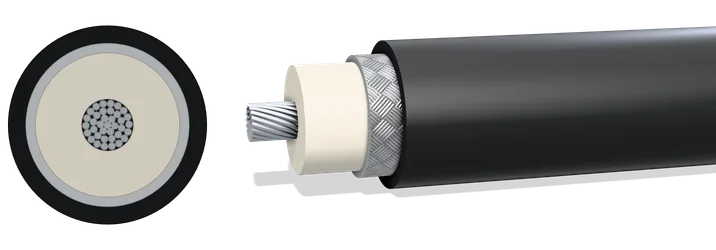
RG 58 CU
50 ohm RF coaxial cable to MIL-C-17
Lead time: On request; the lead time is stated in the quote.
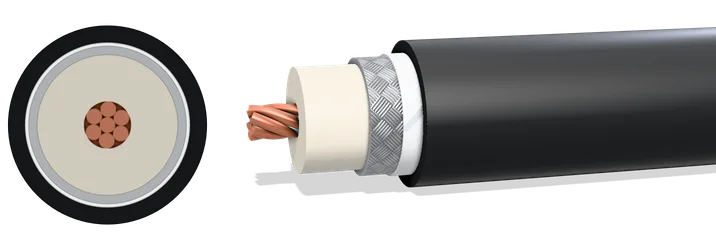
RG 213 TY-ZH
50 ohm RF coaxial cable to MIL-C-17, LSZH
Lead time: On request; the lead time is stated in the quote.
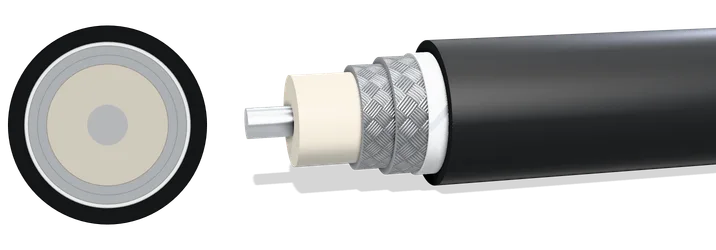
RG 223 U-ZH
Double-screened 50 ohm RF coaxial cable to MIL-C-17, LSZH
Lead time: On request; the lead time is stated in the quote.
Not seeing what you need? Just ask. Our range goes well beyond this list. Ask us →