
Fibre optic tight-buffered OS2/OM4
Tight-buffered indoor OS2 singlemode and OM4 multimode, LSZH
The tight-buffered indoor cable is made for patching: a tight 900 µm buffer, LSZH, in OS2 (distance) or OM4 (fast, short in the data centre). Supplied to order; the lead time is stated in the quote.
This tight-buffered indoor cable carries 900 µm tight-buffered optical fibres for indoor riser, distribution and patch/breakout use inside buildings. Unlike a loose-tube cable, each fibre has a 900 µm tight buffer applied directly over the 250 µm coating, which makes the fibre robust and directly connectorisable and lets the cable be broken out and terminated without a fan-out kit. The buffered fibres are surrounded by aramid (or E-glass) yarn strength members and a low-smoke halogen-free (LSZH) outer sheath with a CPR reaction-to-fire class for use in buildings. It is available with singlemode OS2 fibres (9/125 µm, ITU-T G.652.D) or OM4 multimode fibres (50/125 µm, IEC 60793-2-10); OM3 and OM5 are available on request. OM4 is the common laser-optimised multimode grade, with a modal bandwidth of 4700 MHz·km at 850 nm. It is fully dielectric, light and flexible, and is supplied in counts up to 24 fibres.
Also known as: indoor fibre optic cable · OM4 multimode
Applications
- Riser and horizontal cabling in buildings and in distribution cabinets.
- Patch and equipment cords; OM4 for fast data-centre links.
What to look out for
- Choose OS2 for distance, OM4 for short high-speed links.
- LSZH sheath: Dca as standard, B2ca on request. State the class the Bbl requires when you enquire; on an extra protected escape route that is B2ca.
- Outdoors and in ducts, choose a loose-tube or universal cable.
- Fibre
- Singlemode OS2 (G.652.D) or multimode OM4, tight 900 µm buffer.
- Strength member
- Aramid yarns.
- Cores
- Tight-buffered fibres, easy to terminate and patch.
- Outer sheath
- Halogen-free, low-smoke (LSZH).
- CPR classification
- Dca (B2ca on request); LSZH sheath.
- Fibre type
- OS2 singlemode 9/125 µm, or OM4 multimode 50/125 µm; OM3 and OM5 on request.
- Attenuation (OS2)
- Max. 0.40 dB/km at 1310 nm; max. 0.30 dB/km at 1550 nm.
- Attenuation (OM4)
- Max. 3.5 dB/km at 850 nm; max. 1.5 dB/km at 1300 nm (cabled, ISO/IEC 11801).
- Fibre count
- Typ. 2 to 24 fibres.
- Application
- Indoor risers, distribution cabinets, patch and equipment cords.
Tight-buffered or loose tube?
Fibre optic tight-buffered OS2/OM4
- 900 µm buffer
- connector fitted directly
loose tube
- 250 µm fibres in tubes
- fan-out kit or splice first
With tight-buffered cable each fibre has a tight 900 µm buffer, so you can fit connectors to the fibres directly, without a fan-out kit. In loose-tube cable, 250 µm fibres lie with excess length in tubes; that keeps them strain-free and protects them from moisture outdoors, but a connector first needs a fan-out kit or a splice. Indoors, choose tight-buffered; outdoors and in ducts, loose tube; and for direct burial, the armoured loose tube.
View Fibre optic loose-tube OS2 (outdoor) →OM4 or OS2 for a data centre link?
OM4
- 100GBASE-SR4 up to 100 m
- eight fibres per link
OS2
- 100GBASE-LR4
- two fibres per link
OM4 reaches 150 m with 40GBASE-SR4 and 100 m with 100GBASE-SR4. Count the fibres as well: SR4 uses four fibres per direction, so eight per link, whereas 100GBASE-LR4 over OS2 uses two. If the link stays within those distances, OM4 is sufficient; for longer links, choose OS2.
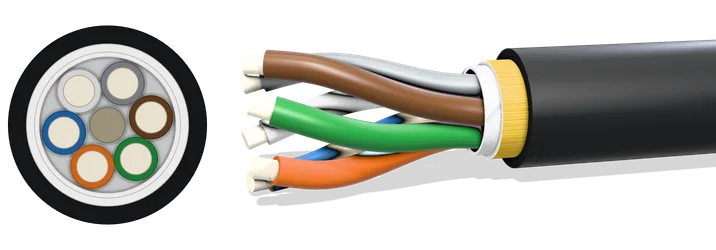
Fibre optic loose-tube OS2 (outdoor)
Outdoor loose-tube singlemode OS2 (G.652.D), duct and tray
Lead time: On request; the lead time is stated in the quote.
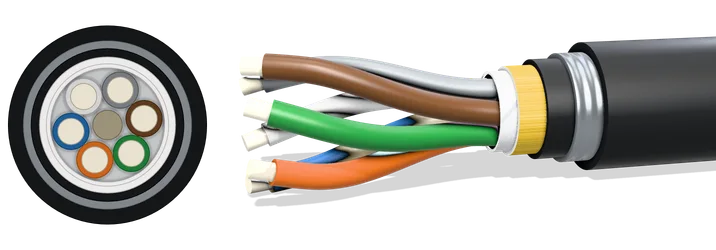
Fibre optic loose-tube OS2 armoured
Outdoor loose-tube singlemode OS2, corrugated steel tape armoured
Lead time: On request; the lead time is stated in the quote.
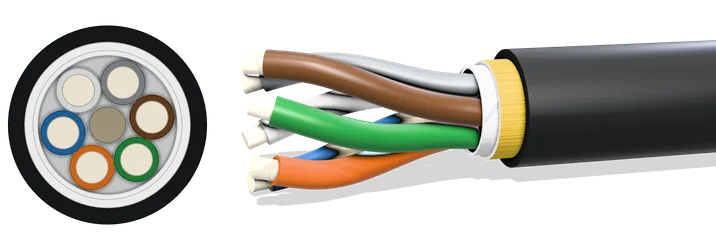
Fibre optic universal OS2 (LSZH)
Universal indoor/outdoor singlemode OS2, LSZH
Lead time: On request; the lead time is stated in the quote.
Not seeing what you need? Just ask. Our range goes well beyond this list. Ask us →