
Cat 7A S/FTP
Category 7A installation cable, foiled pairs + overall braid (S/FTP), LSZH
Cat 7A S/FTP is the highest-bandwidth cable to 1,000 MHz: fully screened, LSZH, for backbone links and future-proof data centres. Supplied to order; the lead time is stated in the quote.
Cat 7A S/FTP is the highest-performing screened four-pair copper data installation cable for structured building cabling, supplied on a reel for horizontal permanent links. Each of the four pairs is built from two solid bare-copper AWG23 conductors insulated with polyethylene (PE / foam-skin PE) and wrapped in its own aluminium/polyester foil; the four foiled pairs are enclosed by an overall braid of tinned copper wires under a low-smoke zero-halogen (LSZH) outer sheath (S = screened overall braid, FTP = foiled twisted pairs). Cat 7A meets Class FA to 1,000 MHz and the tight per-pair and overall screening gives the best insertion-loss and crosstalk headroom of the copper categories; cables of this construction are commonly tested well beyond 1,000 MHz (1,200–1,600 MHz), supporting higher-grade components and 25GBASE-T over short channels. It carries 10GBASE-T to 100 m with large margin, all lower Ethernet grades and Power over Ethernet to IEEE 802.3bt (Type 4). Class FA links are normally terminated on GG45 or TERA connectors (backward-compatible with RJ45 for lower classes). The LSZH sheath (CPR Dca or B2ca) suits indoor routing in public buildings (the required class depends on the building use and the type of space, Bbl table 4.42); a PVC-sheathed Eca variant is offered for less demanding environments.
Also known as: network cable · LAN cable
Applications
- Aggregation and backbone links with maximum bandwidth.
- Future-proof data centre and commercial cabling.
What to look out for
- Requires Class FA connectors for full performance.
- Four pair screens plus a braid: keep to the bending radius (4 × the outer diameter once installed, 8 × during installation) and allow extra termination time per outlet for the screens.
- Conductor
- Solid bare copper, AWG 23 (nominal 0.57 mm).
- Insulation
- Polyethylene (PE).
- Pair screen
- Aluminium/polyester foil per pair.
- Overall screen
- Tinned copper braid (S/FTP).
- Cores
- 4 twisted pairs, 100 Ω.
- Sheath
- Halogen-free, low-smoke (LSZH).
- CPR classification
- Dca-s2,d2,a1 or B2ca-s1a,d1,a1 (LSZH); Eca for the PVC variant.
- Category / class
- Cat 7A / Class FA.
- Frequency range
- Up to 1,000 MHz.
- Characteristic impedance
- 100 Ω.
- Screen
- Foiled pairs + overall braid (S/FTP).
- Conductor
- 4×2×AWG 23.
Cat 7A or Cat 6A?
Cat 7A S/FTP
- Class FA, 1,000 MHz
- margin above 10GBASE-T
Cat 6A
- Class EA, 500 MHz
- 10GBASE-T over 100 m
Cat 7A (Class FA) is specified up to 1,000 MHz, Cat 6A (Class EA) up to 500 MHz. For 10GBASE-T over 100 m, Cat 6A is sufficient; Cat 7A adds margin on top. You only achieve the higher class with GG45 or TERA connectors, because with RJ45 the link stays Class EA. Choose Cat 7A if the specification asks for Class FA, and Cat 6A otherwise.
View Cat 6A S/FTP →Cat 7A or Cat 7?
Cat 7A S/FTP
- Class FA, 1,000 MHz
- needs GG45 or TERA
Cat 7
- Class F, 600 MHz
- needs GG45 or TERA
The build is the same: S/FTP with a foil around each pair, a tinned copper braid and AWG 23. Cat 7A is specified up to 1,000 MHz (Class FA), Cat 7 up to 600 MHz (Class F). Both need GG45 or TERA connectors for their class. If the specification names Class FA, it becomes Cat 7A; for Class F, Cat 7 is sufficient.
View Cat 7 S/FTP →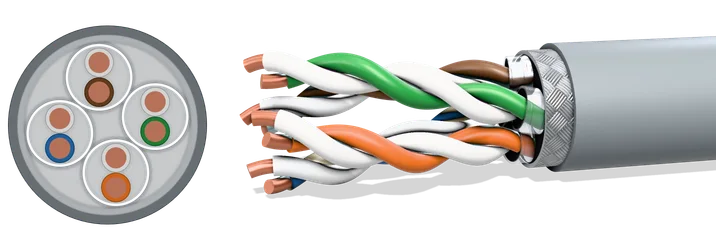
Cat 7 S/FTP
Category 7 installation cable, foiled pairs + overall braid (S/FTP), LSZH
Lead time: 1–2 working days from stock
In stock: 4×2×AWG 23
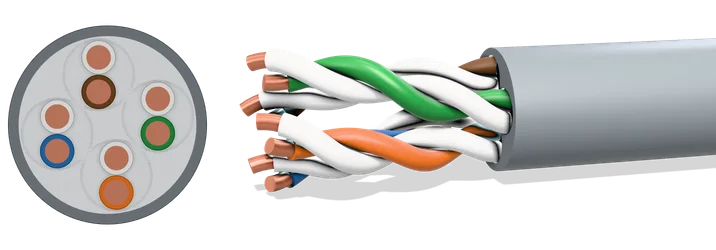
Cat 5e U/UTP
Category 5e U/UTP LAN installation cable, Class D
Lead time: On request; the lead time is stated in the quote.
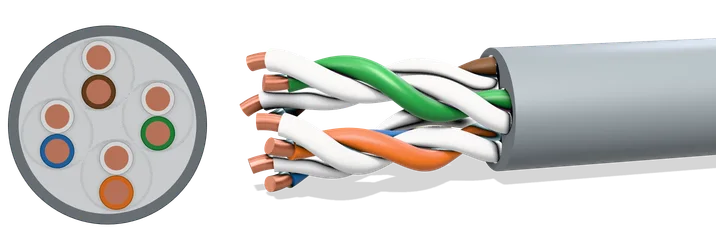
Cat 6 U/UTP
Category 6 U/UTP LAN installation cable, Class E
Lead time: On request; the lead time is stated in the quote.
Not seeing what you need? Just ask. Our range goes well beyond this list. Ask us →