Fibre optic ADSS OS2 (aerial)
ADSS aerial singlemode OS2, all-dielectric self-supporting
ADSS is the self-supporting, metal-free aerial fibre: safe to string along high-voltage lines without induction or earthing issues. Supplied to order; the lead time is stated in the quote.
ADSS (all-dielectric self-supporting) is an overhead aerial fibre optic cable designed to span between poles or pylons and carry its own weight without a separate messenger wire. It is built entirely from dielectric materials, with no metal in the cable, so it can be strung on the same structures as power lines without picking up induced voltage and without special earthing. The 9/125 µm singlemode fibres (ITU-T G.652.D, category OS2) sit with excess length in gel-filled loose tubes SZ-stranded around a central non-metallic strength member; a layer of torque-balanced aramid yarns (or glass rovings) around the core carries the tensile span load, and a black UV-stabilised polyethylene (PE) outer sheath protects against weather and sunlight. For spans within high-voltage electric fields a track-resistant (AT) sheath is used, rated for space potentials up to about 25 kV, to resist dry-band arcing. It is supplied in fibre counts from 4 up to 144 fibres, with span capability up to roughly 1000 m depending on the design and loading.
Also known as: aerial fibre optic cable · ADSS
Applications
- Aerial fibre links between poles and buildings.
- Cabling along or on high-voltage infrastructure.
What to look out for
- Choose the mechanical class (span/wind load) to match the route.
- ADSS needs its own suspension hardware (helical clamps) and a span calculation: state span, sag and wind zone when you enquire.
- Fibre
- Singlemode OS2 (ITU-T G.652.D), 9/125 µm.
- Buffer
- Gel-filled loose tubes around a central dielectric strength member.
- Strength layer
- Aramid yarns around the core (all-dielectric, self-supporting).
- Water blocking
- Longitudinal water blocking (gel or swellable elements).
- Outer sheath
- UV-stabilised polyethylene (PE), black; track-resistant (AT) sheath for spans in strong electric fields (space potential up to approx. 25 kV).
- Fibre type
- OS2 singlemode, 9/125 µm, G.652.D.
- Attenuation
- Max. 0.40 dB/km at 1310 nm; max. 0.30 dB/km at 1550 nm.
- Fibre count
- Typ. 4 to 144 fibres.
- Span / installation
- Aerial, self-supporting between poles; span per mechanical class.
- Metal content
- None (all-dielectric); no induced voltage and no earthing needed along power lines.
ADSS or fibre in the ground?
Fibre optic ADSS OS2 (aerial)
- self-supporting between poles
- aramid yarns, no metal
fibre in the ground
- protected underground
- in a duct or armoured
ADSS hangs self-supporting between poles or buildings: aramid yarns carry the span and the cable contains no metal. A loose-tube cable in a duct, or an armoured one directly in the ground, lies protected underground but needs digging. Choose ADSS where poles are already in place or digging is not possible, and fibre in the ground where an underground route is possible.
ADSS with a PE or AT sheath?
Fibre optic ADSS OS2 (aerial)
- UV-stabilised PE sheath
- vulnerable to dry-band arcing
AT sheath
- track-resistant AT sheath
- resists dry-band arcing
The standard sheath is UV-stabilised PE. If the cable hangs in the electric field of a high-voltage line, choose the track-resistant AT sheath, suitable for a space potential of up to about 25 kV. That sheath resists the small discharges that can attack a PE sheath under wet and polluted conditions (dry-band arcing). Which sheath is needed follows from the space potential where the cable hangs.
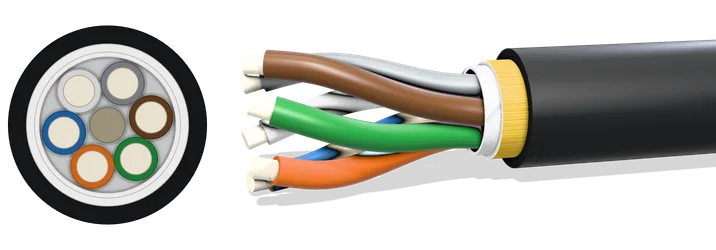
Fibre optic loose-tube OS2 (outdoor)
Outdoor loose-tube singlemode OS2 (G.652.D), duct and tray
Lead time: On request; the lead time is stated in the quote.
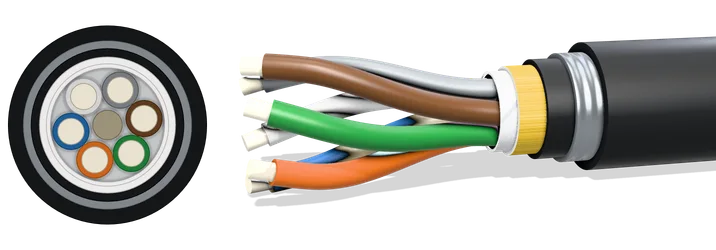
Fibre optic loose-tube OS2 armoured
Outdoor loose-tube singlemode OS2, corrugated steel tape armoured
Lead time: On request; the lead time is stated in the quote.
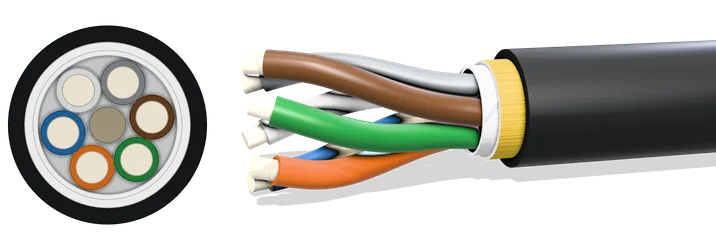
Fibre optic universal OS2 (LSZH)
Universal indoor/outdoor singlemode OS2, LSZH
Lead time: On request; the lead time is stated in the quote.
Not seeing what you need? Just ask. Our range goes well beyond this list. Ask us →